
As a top-tier African, and global, business school, GIBS celebrates its research as it gives a valuable insight into the dynamics of the continent’s economic and business landscape.
Books
Books form an important component to the business school’s body of research. They allow for greater exploration into a topic due to their length, and they can include multiple subjects, views and research, while still being rigorous scholarly works. The start of 2025 saw two books being released by GIBS academics.
Essentials of Leadership in Africa
Bella Galperin & Caren Scheepers (Routledge: 2025)
https://doi.org/10.4324/9781003020523
Essentials of Leadership in Africa, by Bella Galperin, Dana Professor at the J.H. Sykes College of Business at the University of Tampa, and GIBS Professor Caren Scheepers, examines leadership’s crucial role in shaping organisations and societies. The book, however, moves away from Western perspectives on leadership, filling a gap by looking at leadership through an African lens.
“Leadership does not happen in isolation,” says Galperin. “It is influenced by cultural, economic, and social factors unique to each context.” This book provides a framework tailored to Africa. “We aim to equip students, managers, and practitioners with relevant insights to enhance leadership effectiveness on the continent,” she says.
The book has seven chapters that cover traits and motives of leaders, leadership styles, and teamwork and motivation. While academically rigorous, it is also practical, explains Galperin. Scheepers, who is passionate about African-focused case studies, says, “We refer to several published case studies on leadership in Africa, giving real-life examples of the theories. In addition, the book contains practical exercises and assessments that help foster learning and application.”
Galperin and Scheepers highlight some insights shared in the book:
- Leadership in Africa is contextual
Effective leadership cannot be fully understood without considering the unique African cultural, social, and organisational environments. Leadership models that work elsewhere may need adaptation to fit the African context. - Leadership is both an art and a science
It involves a mix of skills, behaviours, and interpersonal dynamics that inspire confidence and collaboration. Successful leaders must balance technical competence with emotional intelligence and adaptability. - African leaders need to redefine leadership
Future leaders in Africa will be required to tackle central challenges in today’s changing technological, economic, and social landscapes. Galperin says, “Our book highlights the importance of equality and inclusion, leadership with ethics, and an African approach to leadership, which draws on pre-colonial heritage, history, and creativity to develop strategies that fit the unique context on the continent.”
What stands out for the authors is that while leadership theories from other parts of the world provide valuable insights, they do not fully capture the dynamics of leadership in Africa. Scheepers explains, “Leadership in Africa is deeply shaped by the African cultural and organisational context. For example, there is a huge emphasis on ubuntu leadership, a focus on leadership as an act of service to the community. That is specific to Africa.”
Essential in business
This book forms part of the Essentials of Business and Management in Africa shortform textbooks which focus on the essentials of various aspects of business and management in the African context. Galperin says, “By focusing on the core elements of each sub-discipline, the books provide a useful alternative or supplement to traditional textbooks and can be used by both trainers and managers.” Scheepers adds, “The strength of this series of books is increased further because they have both international and local researchers collaborating.”
The two other books in the series are:
- Essentials of General Management in Africa by Betty Jane Punnet and Lemayon Lemilia Melyoki
- Essentials of Organisational Behaviour in Africa by Betty Jane Punnett and Thomas Anyanje Senaji
Essentials of Leadership in Africa (ISBN 9780367435202) can be bought directly from Routledge, Taylor & Francis Group for £52.99 for a hardback or £16.99 for an e-book.
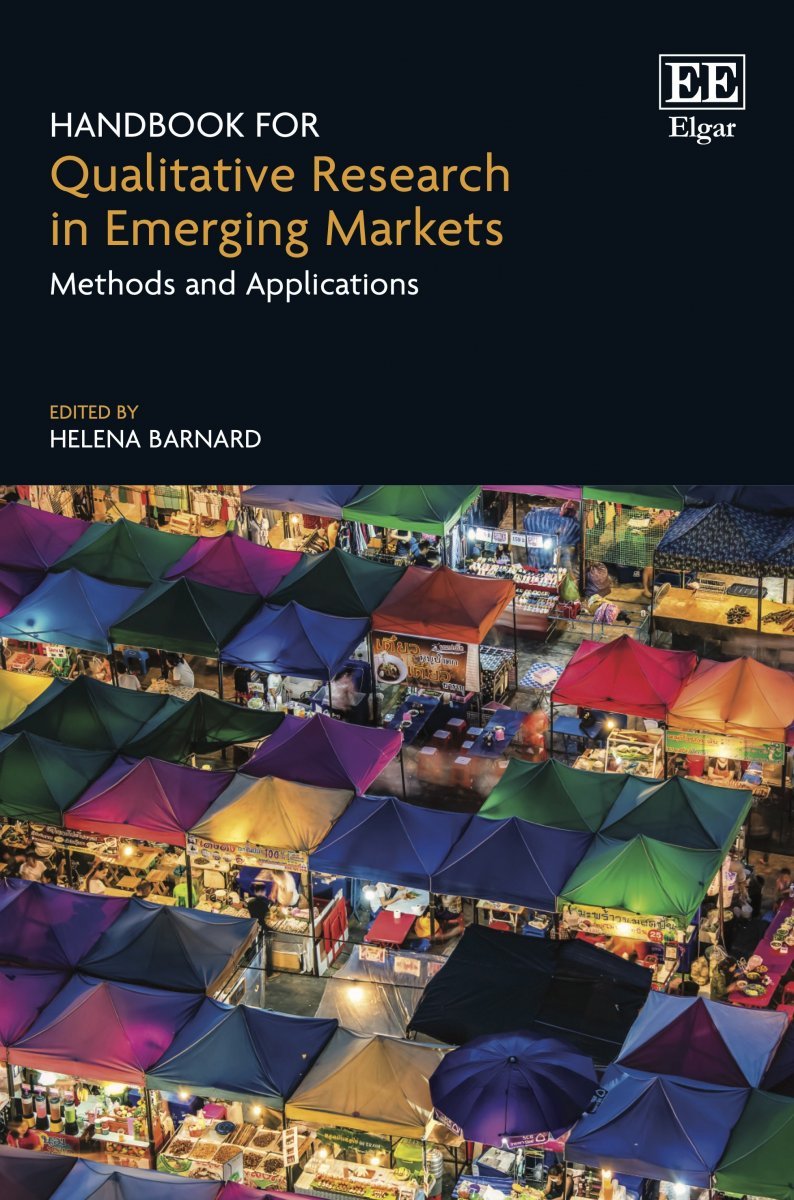
Handbook For Qualitative Research In Emerging Markets: Methods And Applications
Edited by Helena Barnard (Edward Elgar: 2025)
World-class research requires consistent research outcomes. This is often easier said than done in the emerging market context. Helena Barnard, the GIBS professor responsible for doctoral programmes and editor of the Handbook for Qualitative Research in Emerging Markets: Methods and Applications, says, “Doing research in emerging markets is different. They are often so underdeveloped, poor, varied and turbulent that when it comes to research, things don’t necessarily work as one would imagine.”
Barnard says the book aims to give researchers insight into the challenges faced when conducting qualitative research in an emerging market context. The book contains first-person narratives describing the challenges the researchers faced when conducting qualitative research in a business and management context in different emerging markets across a range of research topics.
She says, “I asked the contributors what they were trying to achieve and what happened during the research. The stories that came out were incredibly rich, and some very interesting trends and insights emerged.”
Barnard says, “We have challenges in gathering data, we have challenges in analysing the data and we then have challenges publishing the data. Given these multiple processes, I was really struck by how hard the process was. There are so many more steps than if you study in an advanced economy.”
Key insights around qualitative research in emerging markets:
- Existing research is not as readily available. As such, researchers need to read more widely across multiple disciplines and assemble an argument, which often can’t be easily linked to existing literature, to form a cohesive body of research.
- Emerging market research participants view the research process as building a relationship and get personally involved, unlike research participants in advanced economies, who accept that the relationship ends after the interview.
- The trust-building process with participants is centrally important and cannot be assumed or taken for granted.
- Not all participants answer accurately, so you need to use other tools to gather data, such as visual cues.
- The review process can be complex for research gathered in emerging markets because reviewers often have biases about what they expect to come out of emerging market research.
Barnard says, “At least now we have evidence that this is not just one researcher who didn’t plan properly or had bad luck. The challenges of gathering qualitative research data in emerging markets have been documented for 17 cases.”
She adds, “It is an achievement that we have documented these stories. It will support scholars to have a reference to cite when they need to say something like, ‘We’ve assembled a patchwork of evidence because there isn’t a solid, reliable source, but if you look across multiple sources, you can see that there are consistent patterns.’”
This book will be an invaluable resource for business and management scholars who are conducting their research in emerging markets.
The Handbook for Qualitative Research in Emerging Markets: Methods and Applications (ISBN: 9781035322312) is sold directly through Edward Elgar for a list price of £175.00 for a hard copy, and £48 for an online copy.
Articles
Research articles, especially those published in peer-reviewed journals, are a primary means of disseminating new knowledge and findings within a specific field. It helps scholars who are looking to build on existing knowledge, identify gaps in research and drive the understanding of a field. We highlight three recently published articles by GIBS academics.
The Nature and Relevance of Team Grit
Paula Audrey Buchel & Charlene Lew
https://www.emerald.com/insight/content/doi/10.1108/ebr-10-2024-0322/full/html
Individually, grit is passion and perseverance used to achieve a goal. But when it comes to teams, how can grit be defined and developed?
GIBS Professor Charlene Lew says, “Up to now, the concept of team grit was not well known. While the academic Angela Duckworth, the preeminent researcher on the subject of grit, has theorised how she believes grit appears in the collective, team grit has not been studied before, either through qualitative interviews or quantitative methods. This research attains both of these goals.”
The research technique used for this paper was groundbreaking. Lew explains that first it used focus groups to understand how teams think about grit. Then, through a multi-phase process of scale development, it provides a measuring instrument that captures the essence of team grit. She says, “Through this research, it is now possible for other students and scholars to measure team grit and its relationship with other concepts.” She adds, “Anybody who wants to embark on a scale development study will find the process described in this article helpful.”
Team grit consists of two parts. First, gritty teams are steadfast in pursuing their goals, but adaptively, to avoid inertia. Second, they have a shared and connected identity that embodies their grit. It is this combination of goal perseverance and connectedness that describes gritty teams.
The key insight for Lew is that team grit is emergent. She says, “By developing a sense of sharedness and collectiveness, teams develop common thinking patterns, thoughts, and emotions. Team grit is an emergent state, which can change and evolve as the team grows. In other words, it evolves over time as the team becomes one.”
This is an important finding because highly pressured environments need gritty teams, and Lew shares five additional findings on how to develop it:
- First, build a culture in which team members can feel safe.
- Goal commitment is equally important and teams need clearly defined and attainable goals.
- Organisations can also purposefully develop team grit by encouraging teams to persevere in attaining their goals, and helping them to develop adaptive skills, such as when they are allowed to remain flexible and resilient.
- A close sense of unity in teams is fundamental to their grit.
- Teams develop grit if they can move to the point that they develop a common identity. It is no longer “me”, but “we”.
Lew says, “Our results show that gritty teams predict innovation and work commitment. These are important aspects of performance that can be developed by developing team grit.”
The article is relevant to business and team leaders who want to develop teams who are able to achieve goals despite high-pressure circumstances. It is also a significant piece of work for scholars who want to study teams.
Green Process Innovation and Financial Performance in Small and Medium-Sized Enterprises in a Developing Country: Role of Resource Orchestration
Listowel Owusu Appiah, Dominic Essuman, Cassiel Ato Forson, Nathaniel Boso & Jonathan Annan
https://doi.org/10.1016/j.jbusres.2025.115210
Green processes have the potential to enhance financial processes, this article found. However, implementing green process innovation can be costly and present many challenges that can overwhelm small and medium enterprises (SMEs).
Evidence from this study indicates that SMEs in developing countries can address this challenge by actively engaging with key suppliers and customers on green initiatives, such as the adoption of clean production technologies.
Key findings:
- A three-way interaction model of green process innovation – green value creation, customer-driven green strategy and financial performance – works best.
- Organisations that engage more in green value co-creation generate greater financial benefits from investment in green process innovation. There is a link between green value co-creation and innovation.
- Appropriate market strategies are required to manage and leverage resources to create sustained competitive advantage.
- Customer-driven green strategies enrich the effectiveness of green value co-creation and its efficacy in enabling firms to manage and exploit green process innovation.
- Green process innovation positively relates to financial performance in manufacturing SMEs in Ghana.
Resource constraints and green awareness in developing countries suggest that SMES in those regions must go beyond merely adopting green process innovation. They need to engage in initiatives that enable them to build the necessary competences for effectively managing and translating such innovations into profitable outcomes.
How Value Perspectives Influence Decision-Making in the South African Private Healthcare Sector: A Cross-Sectional Comparative Study
Anchen Laubscher, Reitze Rodseth, Francois Retief & Adrian Saville
https://doi.org/10.1371/journal.pone.0316547
In the healthcare sector, every healthcare clinical event aims to create value, but it’s at a cost. This paper looks at a third factor, that of the patient experience, and how these three factors relate to the value of care in the South African private healthcare system.
The study examined the views of both consumers and providers of healthcare across the general, surgical, and medical categories and three findings stood out:
- All participants valued patient experience above event cost, but lower than clinical outcome.
- There were significant differences between consumers and providers in the relative value assigned to each of the three factors.
- These values changed as the severity of the surgical and medical scenarios changed.
The most significant finding was that patient experience was consistently assigned a higher value than event cost, thereby making a strong argument for its inclusion into the healthcare value equation. These findings suggest that patient experience should be included as a factor in the value care index (VCI) where VCI = (outcome ÷ cost) x patient experience.
This paper is for business leaders and scholars involved in South Africa’s healthcare sector and provides a basis for further research in healthcare beyond the private sector.


Gallery