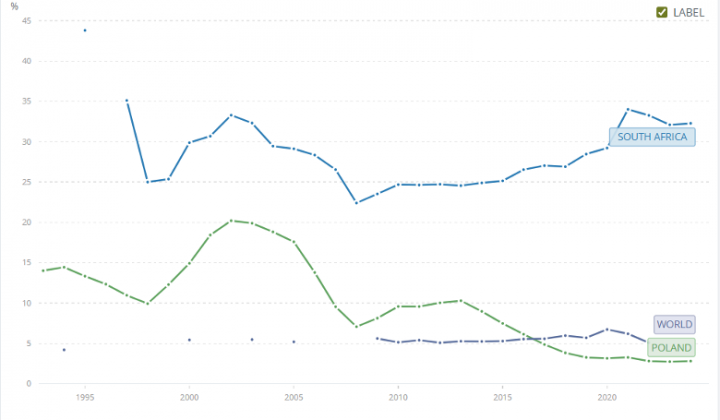
A fraction of South Africa’s science and technology-focused graduates are women – 13%, according to 2022 figures. This is on par with African contemporaries such as Rwanda, Kenya and the Democratic Republic of the Congo, but significantly below the global average of 35%. It’s hardly a surprise, therefore, that only 23% of people employed in science, technology, engineering, and mathematics (STEM) professions are women.
Querying this sorry state of affairs in their 2022 research article, Kaluwa Siwale and Gwamaka Mwalemba asked: what’s causing the “leaky pipeline”?
They arrived at an abundance of reasons, from personal interest to family and social pressures, socio-cultural beliefs, self-confidence, gender expectations, a lack of role models, fewer educational opportunities, and insufficient exposure to technology from a young age. More insidiously is an issue being explored by several GIBS Manufacturing MBA graduates: a system that has multilayered barriers to entry and success.
About 40% of GIBS Manufacturing MBA, run in partnership with the Toyota Wessels Institute of Manufacturing Studies (TWIMS), graduates are women. Of this number, a significant proportion single out inherent bias – and even bullying – as a career-limiting reality.
Take Disebo Mareletse, for instance.
With a background in chemical engineering, Mareletse was snapped up by a major multinational for advancement through their accelerated management training process. This ultimately saw her leading a team from the factory floor. However, as she rose up the ranks and began to question the system, she increasingly found herself without the operational support to succeed in the role. She was subjected to condescension and bullying, her ideas were dismissed, and her perspective disregarded.
As she recalls, “It was hard to navigate, as I was the only person that looked like me – a black female.”
While Mareletse believes many organisations are well advanced in terms of gender equity awareness, manufacturing remains extremely male-dominated, with women largely fulfilling support roles. It was only when she began to speak to other female managers, and report to a woman, that Mareletse began to see the pattern of pressure being exerted on women. After eight years in an increasingly toxic environment, she had a lightbulb moment about the number of women who give up on manufacturing early in their careers. “I had to decide whether to save my mental health or stay to the end,” she recalls.
Mareletse, who now works for an industrial manufacturer, opted to use academia as a way to advocate for change.
Resilience meets resistance
As part of her 2022-2023 MBA, Mareletse explored the personal resilience strategies women leaders in South Africa use to navigate gender discrimination. She interviewed 15 women with an average of 15 years in their industry, ideally team leaders with organisations employing 200 people or more. The result was a workable framework that manufacturing companies can apply if they are serious about helping female leaders to get ahead.
Standout factors
Two of the core findings from Mareletse’s research focused on the strategies women use to navigate often tricky and toxic environments, as well as the unsung role of men in this discussion.
In her experience, Mareletse found “building concrete relationships” with her team, most of whom were male workers, and showing them respect and consideration, helped to forge strong ties and mutual respect. Other women adopted resilient strategies such as building networks of support, often comprising other women as well as husbands, family members, friends, and church communities. The role of mentors and coaches came through strongly. However, these strategies were not enough to help women leaders navigate a tsunami of long-held cultural resistance to gender transformation.
Organisational backing and transformation is, therefore, indispensable. Enabling policies are all good and well, says Mareletse, but unless the culture is supportive and discriminatory practices and biases within the organisation are actively identified and addressed, then these ambitions are worthless. This is why the support of progressive male leaders is so crucial.
Men such as Nkhethoa Molapo.
An advocate for all
A logistics and warehousing entrepreneur, with a background in mining-related civil engineering, Molapo enrolled for a GIBS Manufacturing MBA (2024-2025) to improve his understanding of the manufacturing sector and all its moving parts. Along with other male students, Molapo chose to do the Leading Gender Transformation in Manufacturing elective, which explores gender-specific challenges and ways in which to involve – and retain – women leaders.
“TWIMS has been a huge revelation in my life… and my male counterparts all had the same view,” says Molapo. “It was my favourite elective and I would advocate for everyone to do it. I don’t think anyone could go through this and not see how important it is to have women in an organisation.”
Ultimately, Molapo researched how women in manufacturing perceive organisational gender diversity efforts aimed at shifting culture. In doing so, he became the first male MBA student to select a gender-related topic.
Inspired by his mother and the other “powerful women in my life”, Molapo’s research and conversations with female leaders in manufacturing – such as Mareletse – gave him a new perspective. “What I’ve heard from women is that the industries are not changing and they are not taking DEI [diversity, equity, and inclusion] seriously. When you do find an organisation that takes it seriously, this is usually leadership driven, so the culture within the organisation has not adopted that thinking. It’s adopted the thinking of the leader, and when that person leaves, it basically goes back to ground zero again,” he explains.
At the same time, he adds that men are finding it extremely challenging to change, but they must. “You cannot expect women to come into an organisation and change it,” he says. “It’s the people who are dominant – those sitting at board level and in middle and lower management – those are the guys that need a different perspective.”
A systemic stalemate
However, judging by Molapo’s research, South African manufacturing at large is a long way from dropping the “us versus them” gender mentality.
While Molapo did not speak to male leaders as part of his research, his perspective as a male researcher affirms how men can champion the advancement of women. Sometimes, men just need a bit of training and perspective, he believes. “For instance, what is appropriate behaviour in the workplace? It sounds rudimentary, but some people don’t understand that. They don’t understand that when you speak to someone in a certain way, how you make them feel.”
Another key issue – which is made trickier as women drop out of the leadership pipeline due to a lack of support and psychological safety – is the need for more senior women. “The longer it takes to bring women on board the longer it takes to build that culture. If there are no women voices at the table it’s harder for more junior women to advocate for change,” says Molapo, who is now using his research and the springboard created by his MBA to help both girls and boys reconnect with their “innate compassion and care for one another”.
This mutual understanding and respect between genders may become even more critical as technologies such as artificial intelligence (AI) begin to reshape the very nature of manufacturing operations.
AI: friend or foe?
Referencing a recent syndicate discussion, TWIMS academic director and GIBS senior lecturer Dr. Lisa Kinnear explains how digital twins (virtual replicas of real-world processes) could potentially be used to manage operations off site. This would fundamentally change the nature of the shop floor and create openings for workers with digital skills, irrespective of their gender. “If we think laterally, it can create opportunities,” says Kinnear.
Mareletse warns against complacency, particularly in light of the Trump administration’s active dismantling of DEI in the United States. “We need to be very vigilant in the months and years to come,” she cautions. “In a country like South Africa, where B-BBEE status is very important, it might be necessary to keep women around, but would the current leaders want women in the room making strategic decisions?”
How will this AI wild card tip the scales for women leaders in a manufacturing tomorrow that will look and act very differently than it does today?
What is TWIMS?
Founded in 2019 with funding from the Toyota Wessels Trust, and supported to this day by the Toyota South Africa Education Trust, the Toyota Wessels Institute for Manufacturing Studies (TWIMS) was the vision of Dr. Johan van Zyl, the late executive chair of Toyota South Africa.
According to Dr. Lisa Kinnear, “Dr. Van Zyl felt that for us to have good economic growth in South Africa, and economic prosperity, we really needed a focus on the manufacturing sector and on capacitating managers and executives to lead the sector by raising the level of strategic management.”
The resultant GIBS Manufacturing MBA was developed with input from TWIMS and, thanks to a generous TWIMS scholarship fund, between 13 and 20 MBA students receive financial support for their studies annually. “This year we’ve given 18 scholarships,” says Kinnear.
Kinnear, who has been involved with TWIMS since the initial curriculum design, has a particular interest in researching the development and role of women leaders in manufacturing. “I’ve been pleased to see that a lot of our students have chosen to do studies on gender transformation. Publishing their work can shape thinking around gender. But, with awareness of gender issues, students can also do things a little differently as leaders in their organisations,” she says. “I take heart in the small things.”
Among this research output is a 2024 paper by Kinnear and Alicia Naidoo (class of 2021-22), which was published in the South African Journal of Industrial Psychology. Based on Naidoo’s research, the research explores how female manufacturing managers cope with work-family conflict.
Kinnear also points to the work of Caroline Garnett (class of 2023-24), which highlights the “imposter phenomenon among women leaders in the manufacturing sector with insights from South Africa and the United Kingdom”. The article is currently undergoing revisions for an international journal.
KEY TAKEAWAYS
- Why do so few women graduates with STEM credentials seek out a career in manufacturing?
- Entrenched cultural blockages and resistance to change may be one organisational problem to consider, which could be countered by creating space for men to act as advocates and supporters.


Gallery