
Why does a four-day week lead to “healthier, happier, more effective and inclusive workforces”?
Charlotte L. Rae and Emma Russell from the UK’s University of Sussex say that more rested employees, who were able to detach from work, could perform better and were “more able to engage their ‘creative brains’”.
Published in 2025, Rae and Russell’s research theorised that employers who moved to a four-day model would become more focused on staff wellness and find innovative ways to handle recruitment and retention. Plus, they would more naturally align with socially responsible practices that help employees thrive, as well as broader social benefits such as reduced emissions from less commuting and lower childcare bills.
On paper, it sounds ideal, but without a strong foundation and flexible labour system, an official four-day working policy may still be a stretch for many countries, including South Africa.
Fragmented and frayed
Prof. Manoel Bittencourt, extraordinary professor of economics at the University of Pretoria, has reservations around a four-day week in South Africa, largely due to a labour market split between an advanced formal economy and a vast informal market. These two camps don’t play by the same rules or require the same human capital, “so we have a lot of people without access to skills and without modern skills that would give them access to good jobs”, he notes.
What works for one market might not support the other, explains Bittencourt, looking back to the work-from-home dilemma South Africa faced during Covid-19. Many people with skills and laptops just needed to master online platforms such as Zoom to keep working flexibly, but for the majority of the population this was not an option. For the average South African worker, online tools and work-from-home flexibility is still a far cry from their working reality or their current skills set.
The cherry on top
Bittencourt, a Brazilian who now calls South Africa home, is familiar with the four-day debate that frequently rears its head in Brazil – usually around election time. As is the case in South Africa, the discussion in Brazil must also consider the current context as well as challenges linked to a history of colonisation, segregation, and an inherited labour force structure.
There is one key difference that sets the two countries apart: social mobility. Societies develop and labour markets expand and diversify when young people acquire technical skills and achieve access to more opportunities than their parents and grandparents, stresses Bittencourt. This generational skills and human capital progression is built up over decades. It boosts national productivity and enables the average citizen to move beyond manual jobs into the so-called knowledge economy.
South Africa has not yet reached this level, he says. “We have a lot of young people who are unemployed, simply because they do not have the skills our economy is looking for, is seeking, is demanding. If our population is not productive – and, remember, productivity is given by education – then we have a bit of a problem.”
Here lies the rub. While skilled workers in the tech world, financial services, or even academia can comfortably do their work from anywhere in the world over four days, and still be highly productive, the same cannot be said for security guards, gardeners, or retail workers. Therefore, if a four-day working week was imposed on these jobs and other informal or part-time roles, it would likely involve a loss of income. This would have deep negative consequences for livelihoods, financial health, wellness, as well as that long-term vision of supporting social mobility.
Fix the system first
In short, if South Africa seriously wants to put its hat in the ring as a four-day working economy, it must pay more attention to developing skills – including modern skills – and improving human capital. This comes back to effective spending on public goods such as education, and systems to counter corruption.
Bittencourt fears that without careful consideration of the South African system and its constraints, opting for a four-day working week now would “only be good for one part of the population but not necessarily in terms of general welfare. Implementing this sort of intervention would be fine for those people working in Sandton or Pretoria, because they have human capital, education, and their productivity will probably increase. I’m concerned about the others.”
South Africa has a lot of work ahead of it, Bittencourt believes, but maybe there is some inspiration to be taken from Brazil’s journey. As Bittencourt explains, those living in the informal favelas of Brazil do have access to good public transport, hospitals, schools, and services, which help residents move up in the world. “You can see a lot of things being provided to people who live in the favela, including skills,” he says. “It’s much easier to leave the favela in Brazil than to leave the township in South Africa, because social mobility is higher.”
Get this right first, then unlocking the benefits of a four-day working week becomes a real conversation.
South Africa’s positive pilot project
South Africa trialled a four-day working week in 2023. It was the first time a developing country, and one from Africa, had tested out the possibility. For six months, some 470 employees allowed themselves to be guinea pigs for both company and country. The change organisation behind the pilot project, 4 Day Week Global, lists 23 knowledge-economy businesses in South Africa and one in Botswana as the final participants in the trial. The group also tracked the results, which surprised on the upside.
Among the participating companies, 49% showed an increase in work ability and a 57% decline in employee burnout. Companies noted a 10.5% average increase in revenue, and a 35% hike in employee mental well-being. At the time, 51% of employees said they would only work five days again if it came with a salary increase, and 13% would not be lured back no matter the financial reward. Of the companies, 95% were certain they would continue offering a four-day working week.
To test this out, Acumen reached out to five of these companies, to determine if they were still running a four-day work week.
Nkwali Compliance Consultants certainly was. Amandla Mkhwanazi, its head of compliance and regulatory affairs, noted that its overall experience had been positive, “but not without challenges”.
Outlining some of the biggest issues faced by the small compliance company, Mkhwanazi singled out:
- Responsiveness – The expectation of same-day responses can clash with team off-days, she noted, point out that it can be challenging to manage schedules when clients and providers are still working five days a week.
- Capacity – Since urgent matters don’t respect schedules, Nkwali Compliance Consultants had put in place a skeleton crew system and escalation rules to add coverage if needed, but “without turning the whole day into a de facto fifth workday”. Similarly, coordination for client training and workshops became more complex to manage.
- Burnout risk – “Packing five days of meetings and production into four can increase intensity,” Mkhwanazi explained. “Junior staff, in particular, need help pacing deep work vs meetings.”
- Measurement – Mkhwanazi noted that “redefining KPIs around outputs (cases closed, submissions filed, learner progress) rather than hours took time” and the company still had not perfected the rotation of off-days fairly across client-facing functions.
- Culture – Leaders had to carefully model the right behaviour, or the potential for WhatsApp and email “creep” was high.
- Communication – With fewer shared days in the office, the company had to become “intentional about team meetings”.
Referencing Bittencourt’s concerns, Mkhwanazi added, “I do think a four-day work week is easier to implement in knowledge work. In sectors where revenue is tied to physical presence, the leap is harder. A shorter week [with the] same output can work if processes and tooling improve, but it’s not plug-and-play.”
Meanwhile, at market research company KLA, managing partner Caitlin Bauristhene explained that they conducted a “thorough analysis of our productivity and connection metrics before, during, and after the pilot. Based on those results, we made the decision that the four-day week itself was not sustainable for us in the long term, and we returned to our hybrid and flexible model.”
However, the insights KLA took away from the process were certainly valuable. “It prompted us to rethink our ways of working, sharpen our focus on outputs rather than hours, set clearer boundaries to protect recovery time, and sparked a wider overhaul of our internal processes and structures in the years since,” she said. “Those learnings continue to inform how we operate today.”
Who is leading the shift?
Twenty-two countries – including South Africa – have begun actively exploring the four-day work week concept. Pilot projects have been carried out in Brazil, France, the United States, Japan, and the United Kingdom, while the United Arab Emirates is testing a shortened 4.5-day working week for government employees. Permutations vary from working fewer hours in total to more hours in a single day, as is the case with Belgium.
Among the reasons for this interest include wellness and improving work-life balance. In some countries where birth rates are in decline, such as Japan, it is seen as a way to incentivise working women to have children while also enabling fathers to take paternity leave.
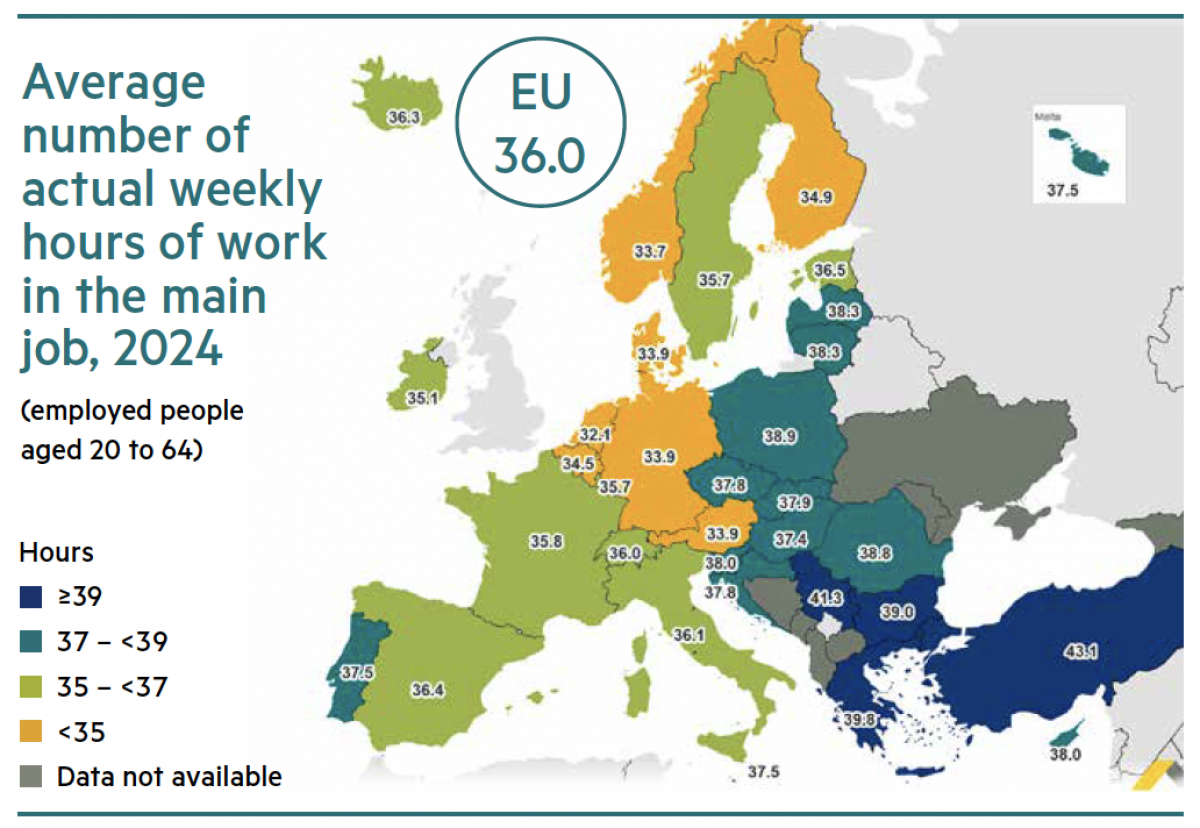
In the Netherlands, the structure of the Dutch labour economy has created a conducive environment for gently transitioning to a widespread four-day system. On an hourly basis alone, the Dutch are already working an effective four-day (32.1 hour) week, the shortest hours of any country in the European Union (EU). Since the 1980s the Netherlands has shifted from a traditional labour model to one that incentivises the employment of women and the provision of part-time work opportunities. Today, almost 40% of all Dutch workers – and 60% of women in the country’s labour market – are employed part-time. A 2019 OECD report also highlights the role tax incentives for part-time work have played in advancing the four-day work week.
In leading African economies such as South Africa and Kenya, the average weekly work hours in 2024 were 41.7 and 45.1, respectively, according to global employment provider Omnipresent. Chinese workers clocked 45 hours, Australians 32.8 and South Koreans 37.9 hours.
In a nutshell
- Studies show that a four-day working week is great for employee wellness, health, and happiness, as well as creativity.
- It is also linked to social benefits and staff retention.
- At least 22 countries around the world are experimenting with the four-day working concept, including South Africa, the Netherlands, Japan, and Brazil.
- Successful implementation seems to go hand-in-hand with labour-force flexibility.


Gallery