
The more data, the more AI can learn at scale, and the smarter the system becomes.
Learning never ceases, for as long as data is coming in. And data will keep coming in if customers keep providing it, because they get perceived value back. AI systems self-correct, upgrade and change the rules, remodelling themselves to keep improving.
Google’s data centre cooling AI system continuously optimises climate conditions, adapting to internal and external factors like room temperature and weather, self-regulating in a positive feedback loop, that has saved Google’s energy by 40%, which it is able to pass onto customers, as well as getting paid to train other institutions.
Data can come from anywhere. Tesla combines data from online customer forums, its cars (fleet learning), devices like traffic cameras and road sensors, and soon other car brands. Maersk gets its data from surrounding vessels and the sea. In digital surgery, Verb Surgical links robots to learn from each other. Yodlee, a US AI platform, finds people who have learnt how to achieve financial health so it can learn to pass it on.
Each interaction is an opportunity to ultimately create customer value – the more interactions, the more learning, the more intelligence can be fed back into the system to make known and not-yet-known connections. This leads to more value for customers in a virtuous cycle.
Virtual interfaces can interact with customers en masse, simultaneously – in China, Tencent’s WeChat converses with millions of customers a day. Bots have none of the old industrial constraints, interacting 24/7, from anywhere to everywhere, taking up no space, working always at peak performance.
Predicting with accuracy
With AI, learning can be more accurate than any human accomplishment. Music streaming giant Spotify predicts what music a person may like, with amazing accuracy. Google’s AI energy innovation can create better learning rules than the researchers who made it!
Increasingly, creative inputs are being used to machine learn. Smart Finance in China knows the likelihood of a customer repaying a microloan, using app typing speed and phone battery percentage.
Prediction can mean becoming an expert in prevention. In healthcare, SemanticMD has achieved a 95% rate of detection for tuberculosis in Africa, Case Western Reserve University 100% for breast cancer. Through AI application from its 20 million car stronghold, Bilprovningen, a Swedish motor-vehicle inspection company, predicts faults and service needs, outperforming any car’s onboard computer.
Discovery Vitality uses machine-learning to predict a hospital patient’s risk of complications, hospital-acquired infections, future re-admissions, or mortality. This accurate and early risk analysis promises better precision of medical diagnostics and outcomes.
Making the collective work for individuals
Aggregated intelligence can be hyper-personalised. This is transforming current practice in medicine from “sick care” to “health wellness”. Discovery can predict an individual’s potential for diseases, for example, and advise them on their specific next best actions.
US Syngenta enhances crop productivity by recommending which soybean variety to plant where, based on a farmer’s specific piece of land. Amazon’s AI has given it a head-start into fashion, generating clothing recommendations for individuals based on their wardrobe and style.
AI knows what customers are doing at any moment in time, enabling enterprises to manage micro-moments in people’s lives, for instance by alerting a customer if they are too drunk to drive (Uber), or recommending a nearby restaurant based on food preference (Waze).
Bots are also progressively able to contextualise by learning to recognise not just what customers need, but how they feel. Spotify knows what music customers may enjoy at a moment in time, based on mood, taste, and occasion. Spanish Bank BBVA’s virtual assistant can detect the caller’s sentiments and reactions and adapt responses. China’s Hema retail disruptor uses AI to get emotional cues from chats, to fix each person’s problems, reportedly ten thousand times more efficiently than customers were getting before.
Zero-delay action
Actions and reactions can have zero delay because learning is turned into intelligence at lightning speed. Said one financial services executive: “A decision which would have taken us 24 hours or more to do, we now do get the answer in seconds.”
Decisions can be made by anything or anyone, because intelligence is decentralised to whatever or whoever, whenever it is needed, signalling an end to old structures and protocol.
Its impact is felt across industries and professions. Huge document loads to prepare lawyers for trial and help with litigation decisions can now be done in real time. Insurance claims can be made superfast, such as SA digital start-up Naked, which can get a claim approved within minutes, including fulfilment.
Globalisation is quicker and more cost effective
When the ongoing capture, analysis, and dissemination of relevant learnings through data becomes the major component of market value creation, globalisation can be both quicker and cheaper. With adaptations, algorithms can be transferred from one market and country to others at scale, speed, and low cost.
Take two South African examples. Discovery Vitality is now the biggest behavioural health platform expert in the world. Having adopted AI to make its already considerable database even larger, it has rapidly expanded globally and is now in 45 countries impacting 45 million customers, who live longer, healthier lives. And Aerobotics, which had its beginnings in the Western Cape focusing on citrus trees, now covers more than 100 million trees of various species in 18 countries, having become the expert in crop productivity, achieved in record time. Said an executive, “Once we have data from one crop in one country we can scale the learning for multiple crops in multiple countries cost effectively.”
Eliminating old trade-offs
Scaled learning produces increasing value at low cost, a winning formula for getting and keeping a competitive advantage. Take Uber: the more riders and drivers it adds, the better able and more cost effective it becomes.
No trade-off has to be made between value and cost.
An Irish bank executive shared the following. “With our AI chatbot deployment we knew about each person’s habits, intention, and situation, so we were able to target and service precisely, making sure each customer got the right response. If customer behaviour changed the system changed. This pushed the cost of transactions down 65%, and the costs will keep going down over time.
“Additionally, because we could assess when customers left a journey and why and fix it we reduced bounce rates by 15-50%, which meant conversion rates increased. We also got jumps in customer satisfaction – recommendations went up 10% and we halved the complaint rate.”
When the cost of expensive physical assets such as call centres or vast branch networks are trimmed, people can be reskilled and redeployed to further add value. Savings can be passed onto customers, attracting more customers and keeping existing ones longer, spending more, further pushing costs down.
Unlike the finite resources of the past, learning has elasticity – it grows as it’s being reused. It can be leveraged over and over therefore, getting and giving value without incurring the set up or marginal costs of the past.
The more time Amazon’s Alexa spends with customers the more data it gets, the smarter it gets, the more pervasive its virtual assistant can become, at minimal added cost. Amazon keeps increasing Alexa’s now over ten thousand skills exponentially, including home automation, shopping, fashion recommendations etc, and it recently extended its presence from homes to cars.
Using generative AI, Alexa can alter what it knows and give answers to questions for which it doesn’t necessarily have premade skills. If a customer asks for a recipe, Alexa can adapt it to the customer request by, say substituting ingredients (no garlic), altering them (fewer calories) or changing amounts to suit a specific number of people.
The point is, once AI setup costs have been covered, expansion to get more to and from customers becomes a virtuous cycle of higher value at decreasing costs.
Singapore’s supercharged Smart Nation AI investment is premised on this principle. New services are increasingly being added from on-demand public transportation – buses, shuttles, aerial taxi, rail, all autonomous – to security, assistive health for aged and smart homes, paid for in one cashless ever smarter system to improve lives.
Learning investments can also be leveraged at low cost by licensing it to other organisations or industries, as Google has done with cooler systems.
Competitive AI framework
AI is most potent when an enterprise knows what it needs to learn, in order to become the expert at doing something better than anyone else, and when it uses the positive force of learning to both get and stay ahead.
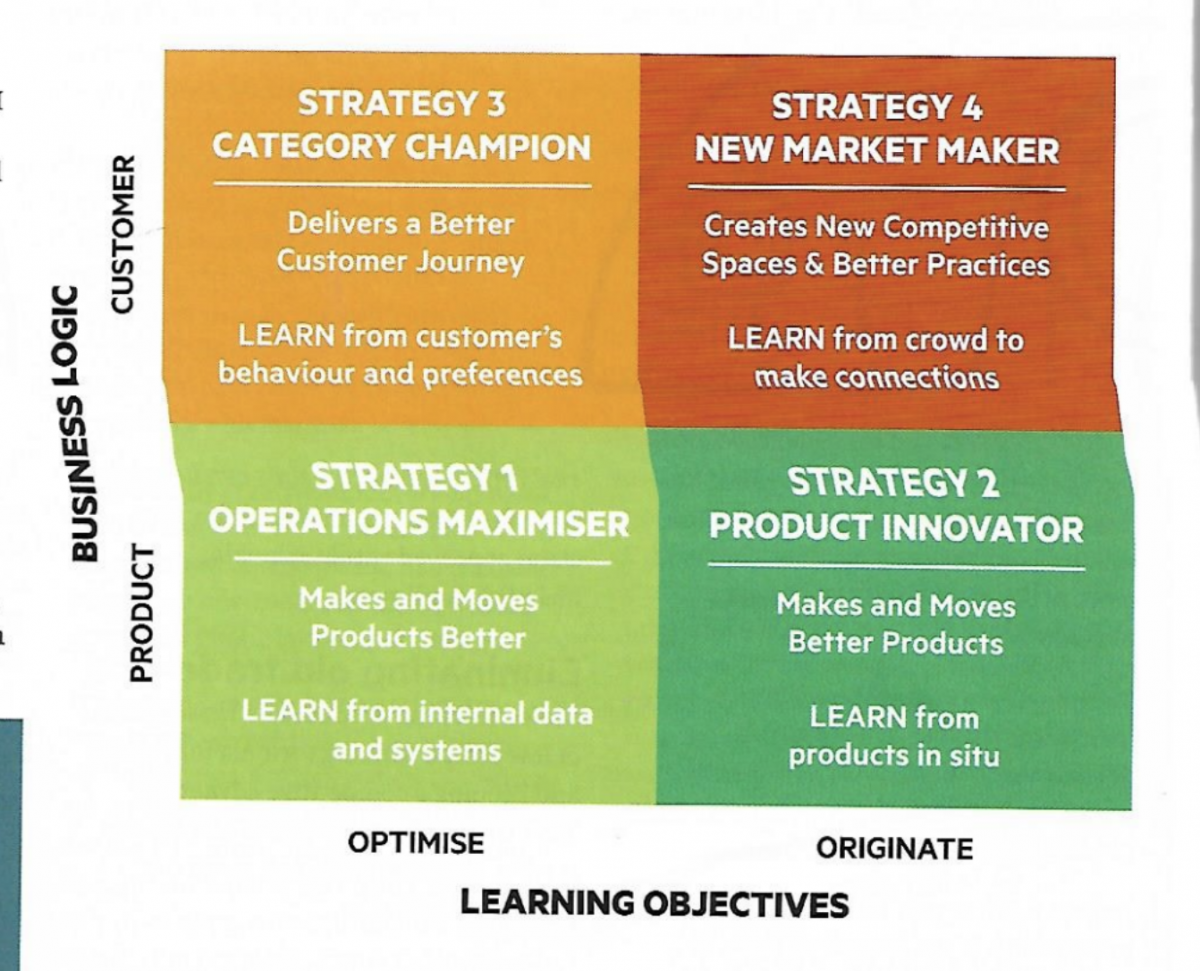
From our research, case studies, and consulting, we believe the approach an enterprise chooses is a function of its business logic – either product or customer centric (y axis), and the objective for learning either to optimise what exists, or originate (x axis). (See Diagram 1).
Four competitive approaches have been identified.
Product logic drives making and moving more stuff. Operations maximisers do this by deploying AI to optimise internal systems, in order to make and move core products better. Product innovators compete by making and moving better products. They originate by adding smart new features to their products, based on real-time learning on how the products perform in use.
Customer-focused logic uses AI to deliver better customer outcomes. Category champions optimise the customer’s journey in a product arena. New market makers originate by changing the business model to create better social and business practice. Mainly platform-based, mostly newcomers, they use AI power to connect products, people, and places, crossing traditional industries, to build new competitive spaces.
STRATEGY 1
Operation maximiser: Makes and moves products better
Case: Zara (B2C)
Competitive advantage: Wins through systems efficiency
Strategic question: How do we get fashion products from factory to customer quicker than anyone else?
AI learns from: Internal data and systems
Zara has concentrated AI to optimise its internal systems to build superior supply chain management. It can get fashion from the factory to the store quicker than anyone else. Its consequent growth has given it the ongoing inventory intelligence that predicts customer buying trends so as to get the right products into stores at record speed, minimising distribution lag, keeping production optimised with near zero stock waste, keeping costs down, and increased affordable fashion availability to customers.
Case: Maersk (B2B)
Competitive advantage: Manages risk through systems efficiency
Strategic question: How do we operate our vessels at sea better?
AI learns from: Ship data and environmental surroundings
Maersk uses AI learning to improve the situational awareness of its container ships at sea to maximise efficiency. Its intelligent risk management capability makes it the expert at identifying and tracking objects and potential conflicts to avoid collision, decreasing potential damage and delays, thereby increasing customer reliability, and ultimately lowering cost.
STRATEGY 2
Product innovator: Make and move better products
Case: Tesla
Competitive advantage: Adapts products to context
Strategic question: How do we design and produce better cars and make them smart in use?
AI learns from: From products in situ
Tesla, pioneer in electric cars, has harnessed the AI embedded within its cars to enable it to do smart things, adjusting to conditions and occurrences in real time. When the car has a problem like suspension it instantly takes action for that car and feeds the learning back into the system. When Hurricane Irma devastated the Florida coast, Tesla remotely upgraded the battery capacity of its vehicles so that customers could escape harm by being able to drive the necessary distances without having to recharge.
STRATEGY 3
Category champion: Deliver a better customer journey
Case study: Hema
Competitive advantage: Offers a better retail journey
Strategic question: How do we deliver integrated in-store and online food shopping?
AI learns from: From customer’s behaviour and preferences
Hema has optimised its system to form smart stores, merging online and offline environments to enhance the customer journey. From billions of searches, customer profiles and behaviour it has built an unrivalled AI capability. As customers choose products or ask questions about, say, origin, ingredients, cooking instructions, nutritional information or price, the system learns more about them, and gets increasingly good at translating this into the millions of personalised pages generated in real time on the Hema phone app. As a result, the system is said to have got better engagement and 100% better click-through rates than that created by people. Adjusting lists, reminders and personalised route guiding are next on the ongoing list to elevate the offering based on learnings.
AI-heavy, stores act as warehouse and fulfilment centres with staff as packers, enabling a delivery of 30 minutes within a three-kilometre radius.
STRATEGY 4
Market maker: Create new competitive spaces and better practices
Case study: Uber
Competitive advantage: Connectivity across products and industries
Strategic question: How do we get people and products from A to B in new better ways?
AI learns from: Crowd to make connections
Uber created a whole new market for never before heard of: ride-sharing. Using AI at its centre it opened the “urban mobility” space, allowing customers to pay for a service or outcome, instead of purchasing the product.
Then it expanded mobility across sectors including helicopters, boats, and more recently electric bicycles and air taxis, expanding its footprint at low cost. That emerged into a “product mobility” space – moving things from food to flu vaccines.
Now it works with competitors. Uber uses AI for almost all of its functions. But at its core, Uber knows how to use its crowd to connect people, products, and places. It knows which people and cars are travelling to where and when, it knows the weather and other conditions. It has learnt how to deliver a real-time personalised experience, matching demand and supply, passenger and driver.
It continues to open up competitive space for itself and its ecosystem, using learnings to originate, making new connections across product and industry. For instance, with Toyota and others, a new space-mobile shop and mobile production (think workers shopping from a mobile vehicle or pizzas being made on the move) has materialised.
In conclusion
The framework presented can be used as a strategic tool by both legacy or newcomer enterprises, who have already embraced AI, to assess where they have aimed their strategy, and if that is where they ideally should be positioned. Alternatively, it can be used for planning an AI-led future strategy.
In both cases these questions serve as useful guides:
- What is the strategic question we need to solve?
- What do we need to know better than anyone else that will answer that question, so we can get and stay ahead?
- Which of the four AI strategy options is most appropriate for us?
Professor Sandra Vandermerwe is an extraordinary professor at GIBS. She works with boards and senior managers globally, across the industrial and service spectrum, on how to achieve sustainable growth and scale through customer centricity, in an ever technology advancing world. Previously at Imperial College Business School, London and IMD, Switzerland, she has published widely and is a bestselling case author, thought leader and keynote speaker. Her work has redefined customer centricity and laid the foundation for many modern business models and language.
David Erixon works in financial services as group marketing director for Aviva (UK) and is also an adjunct professor at Trinity Business School (IE) on customer centricity and innovation. His latest book Distinguishers, co-authored with Prof. Sandra Vandermerwe, lays out the recipe for winning customers at speed, scale and lower costs. Founder of digital school Hyper Island (SE) and service design agency Doberman EY (SE), he has worked in all corners of the world in telecoms, financial services, media and FMCG, always with one foot in higher education.
Alison Jacobson is a business strategist and disruptive thinking partner, helping organisations apply AI to complex strategic challenges. She specializes in outcomes-based strategy, working from unmet customer needs backwards to drive real impact. As the former head of digital advisory at Dimension Data and a director of The Field Institute, she has guided C-suite leaders through customer-centric, technology-enabled transformation. At Strideshift Global and d-lab (a non-profit), she pioneers AI-driven growth, rethinking business and society for exponential impact.


Gallery