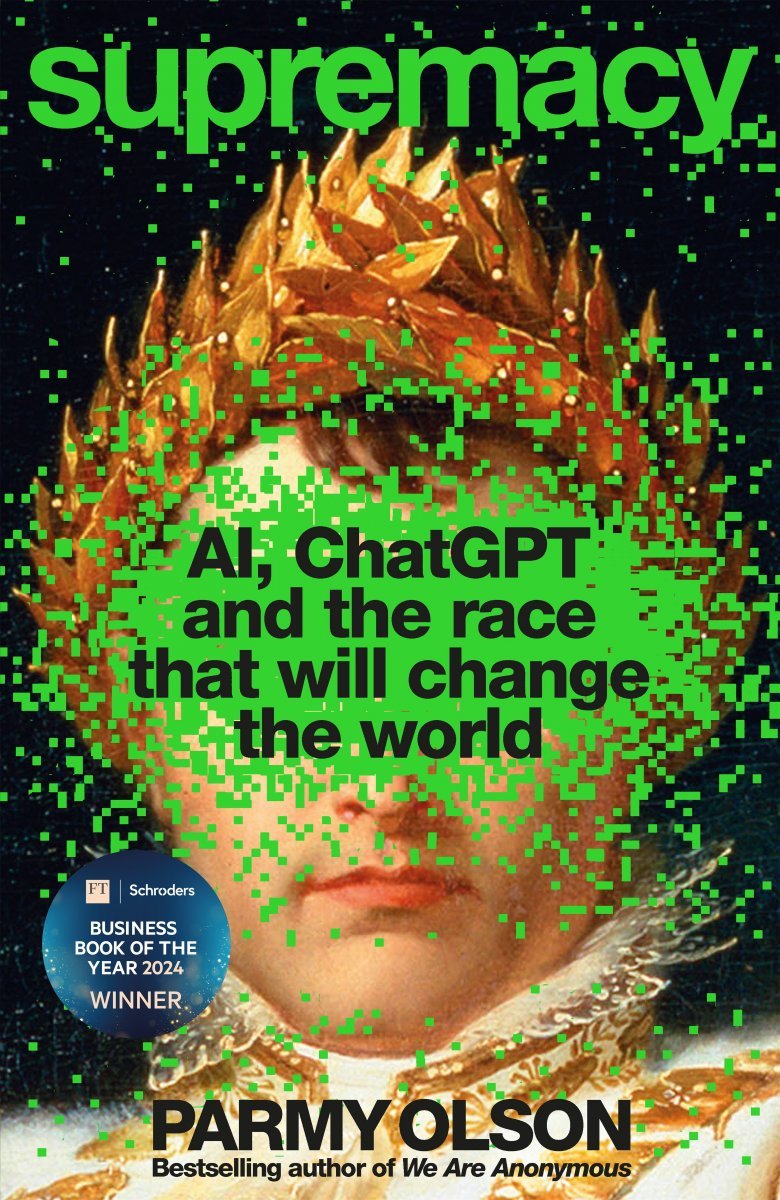

Supremacy
Parmy Olson
Pan Macmillan – R425
This is a book that I’m glad I didn’t write. Not because I would not have wanted to win The Financial Times Book of the Year 2024 prize, which Supremacy certainly did. Nor because it’s not deeply researched and extremely well written, because, again, it certainly is. Nor even because it’s not a gripping tale of two extraordinary men and two giant corporations, locked in a race against time to develop technology that might either save the world or possibly destroy it.
I would not have wanted to write this book because very shortly after it was published, an event took place which almost certainly demolishes the central pillar of author Parmy Olson’s thesis. Allow me to explain.
This is the story of the contest between Demis Hassabis of DeepMind and Sam Altman of OpenAI. Their challenge was to develop artificial general intelligence (AGI), the dream of computer scientists for decades, which, if it is ever found, would possibly allow machines to think better than humans. It might also allow those same machines to take over the world and even to destroy us or the world itself. (Stress the words ‘might’ and ‘possibly’ in those last two sentences!)
Artificial intelligence (AI) as we know it today is driven by machine learning and algorithms and when Hassabis and Altman began their journeys in 2010 and 2015, respectively, it was a relatively primitive concept. The jump from AI to AGI was thought to be maybe 50 years in the future.
The pair also start from different places, Hassabis in London and Altman in San Francisco, with very different approaches. Hassabis, a former chess champion, is methodical, research-driven, and very cautious about AI’s potential for harm. Altman is also worried but perhaps less so than Hassabis; culturally, he’s a much more of a West Coast, Silicon Valley risk-taker than Hassabis, whom Olson defines as British and hierarchical. Hassabis wants to develop solutions that will cure cancer; Altman wants to make work obsolete and give everyone on the planet thousands of dollars.
Very quickly, however, they both develop an identical need, which is for huge amounts of computing power and the money to pay for it. The only companies with that amount of firepower are the tech giants; DeepMind is swallowed by Google, OpenAI by Microsoft.
Supremacy is the story of how this happened, how Altman and Hassabis changed their objectives, how – eventually – they embraced their enormous tech parents and, in Olson’s view, how their original goals of benefiting humanity have been subsumed into the drive for growth and profits. One important casualty occurred along the way: both firms and their founders embraced openness, publishing research papers, revealing source code, and building methods. But as they disappeared into the corporate maw, their businesses became more and more opaque, shrouded in secrecy.
Olson ends off speculatively, wondering what the next steps might be, but she concludes that because of their sheer size and domination, the benefits of AI – maybe eventually AGI – will accrue not to humanity, but to Google and Microsoft, firms like them and their shareholders.
It’s a fine theory, except for one thing. Within weeks of Supremacy’s publication, in January of this year, a Chinese company called DeepSeek burst onto the AI scene. As I write this, we’re still coming to terms with it – apparently, it’s much, much cheaper to build and its software is open source, which means anyone can take it and use it without massive licence fees or subscriptions. Of course, “open source” can mean many things – Google’s Android operating system is open source, for example – and there are worries about DeepSeek’s ties to the Chinese government. But if the hype turns out to be true, it changes how we view the future of AI completely.
Don’t let that put you off, though. Supremacy is an excellent read and I learnt a great deal about AI. I’ll also lay money that Parmy Olson will update it or follow it with a sequel in a year or two from now – I’m already looking forward to that!
House of Huawei
Eve Dou
Abacus Books – R470
This is a tough one.
Anyone with the vaguest interest in technology or geopolitics will be aware of Chinese telecoms giant Huawei. From humble beginnings in the then-almost coastal village of Shenzhen, near Hong Kong, it has risen to be the No.1 seller of switchgear in the world. At one stage, just before the pandemic, it was the biggest cellphone maker in the world, ahead of Apple and Samsung.
It has also become a target of intense scrutiny – some would say hatred – by successive US administrations. Trump 1.0, followed by Biden, have persuaded – some would say bullied – quite a few major nations including Britain, France, Germany and Australia to rip out existing Huawei equipment from their 5G networks. The US says that, in essence, Huawei is either an arm of the Chinese state or cooperates very closely with it when it comes to surveillance technology and snooping on users of its cellphone networks.
Huawei, of course, denies these charges but that didn’t stop Canada from detaining its CFO Meng Wanzhou, also daughter of founder Ren Zhengfei, following a US extradition warrant. China struck back immediately, detaining and charging two Canadians with espionage.
So, it should be a great tale?
Except Washington Post technology reporter Eva Dou made the wrong decision as she set out. The first half of her book deals with the early history of Huawei, and it’s a very meticulous but dull list of obscure executives, difficult deals in far-flung parts of China and technical achievements which could interest only the most nerdish of business historians. It should all have been covered in a single opening chapter, leaving us to get straight to the meat of matter: America vs Huawei.
Only on page 216 of this 400-page book do we arrive in Washington at the Congressional hearing that resulted in the US government ban on Huawei. From here on, Dou provides us with a gripping account of the titanic battle between the world’s most powerful nation and its biggest telecommunications maker.
Dou is very strong on Huawei itself, its relationship with the Chinese government, its ultimate ownership and the fact that this mirrors the Chinese state itself. Sadly, less so on America’s motivation for hunting Huawei and trying to put it out of business. Yes, there are security concerns about Huawei being able to leave a “back door” open in its technology to enable China to spy on rivals. But governments, including Washington, do a lot of this anyway – much more than we’re aware of – witness exiled whistleblower Edward Snowden and his leaks on America’s National Security Agency.
There has always been a sense that the American concerns about Huawei have been driven largely by its very ability to outshine similar firms in the West, and America, in particular. In other words, it’s a persecution for old-fashioned commercial reasons. Dou does not, in my view, delve deeply enough in this area.
Nonetheless, in the book’s second half, she provides a very compelling account of the relationship between telecommunications companies and their governments, and why politicians are so keen to champion these companies.
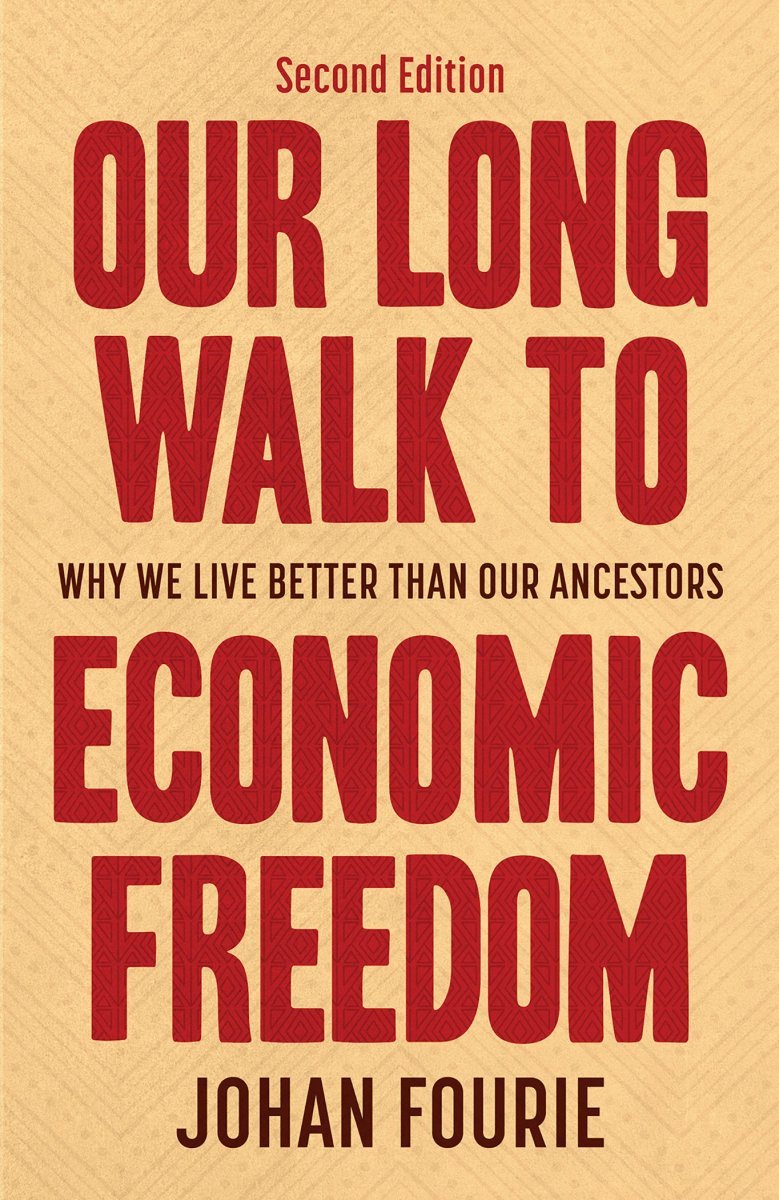
Our Long Walk to Economic Freedom (Second Edition)
Johan Fourie
Tafelberg – R380
The book’s subtitle gives a clue to its contents: Why We Live Better Than Our Ancestors – but it could just as easily have been something like How to Create Prosperity. It’s one of the central questions in economics. Get it right and our descendants will live better lives than us; get it wrong and we regress into poverty.
Johan Fourie is a professor of economics at Stellenbosch University, but with a special interest in economic history, especially of the African and South African variety. He believes that for us to understand where we are today, we must examine how we came to be here. In other words, look closely at the historical evidence. Ignore the evidence and view the past through a lens of belief or ideology, and all you’ll be left with is a fantasy, says Fourie.
Fourie takes a mere 37 concise chapters to race through human history and to distil the economic evidence he collects en route. No surprise given his interest that much of this relates to Africa, and South Africa, in particular. The chapters are easy to read – Fourie makes it clear that this in no way a specialist economics textbook – and could be read individually. That might be something of a mistake, however, because each chapter builds on what has gone before, allowing Fourie’s argument to gain momentum.
Inexorably he brings us to South Africa in 2025, a country being crushed by low economic growth and massive unemployment. How do we turn this around, Fourie asks? His conclusion, based on the historical analysis, is that we need to stop making bad decisions, drive education and healthcare, and encourage economic freedom. The evidence he presents tells us that under these conditions, nations thrive, but when there is too much government or business becomes overmighty the reverse occurs.
Fourie’s tale is compelling but is anyone listening?


Gallery