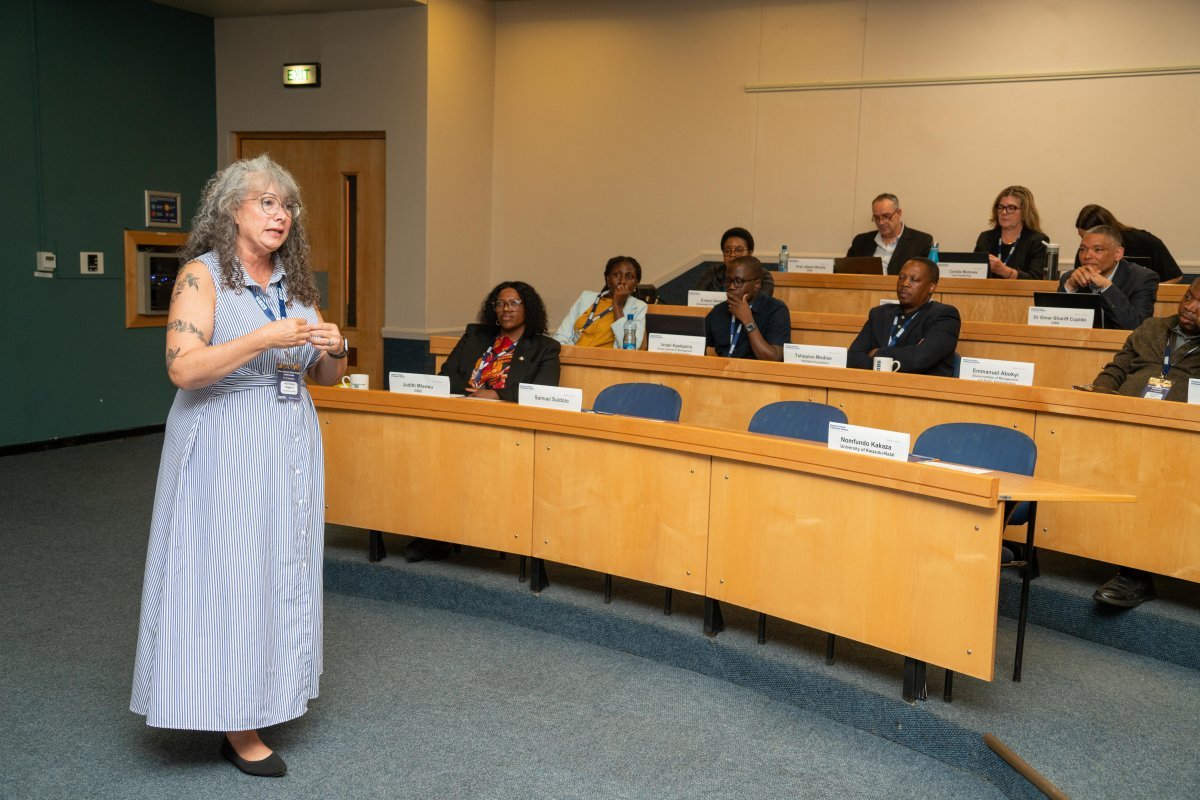

Business cases grounded in African realities help students and faculty everywhere develop sharper judgement, greater adaptability, and deeper humanity, says Dr. Nicole Haggerty, associate dean of faculty at Canada’s Ivey Business School.
Haggerty delivered the keynote address entitled Flipping the Script: What African Business Cases Can Teach the World at GIBS late last year.
Ivey Publishing, a leader in global business case studies, holds more than 8 000 cases, adds about 350 each year and provides teaching notes for virtually all of them.
Haggerty highlighted the dominance of northern stories in global case libraries. Ivey published 1 600 cases in 2024, of which only about 50 were Africa-related. Harvard’s collection runs to 33 000 cases, but just 1 000 are set on the continent and many of those focus on multinationals or foreign actors, not African businesses themselves.
“The world needs these African stories, but they cannot be written by outsiders. They must be written by people here, with contextual knowledge and lived experience,” she said.
Haggerty has worked across the continent and last visited GIBS in 2013. Opening her address, she reflected on walking into her first undergraduate class at Ivey nearly 40 years ago, where teaching was rooted in the case method.
Before entering academia, she spent nine years in the private sector, rising from account manager to vice-president within five years and eventually running a division. She then left the private sector to return to academia, where she has since written around 50 cases, half of them set in Africa through a management education initiative. Her 2013 visit to GIBS was to seek new partners, some of whom were present at this year’s conference.
Delegates noted that cases from the Global North often carry certain assumptions, including:
- Cases are structured around decision points where the protagonist seems capable of resolving the issue. That’s what makes them compelling and you want to know what happens next.
- They assume lessons are generalised across cultures and geographies. Background notes are useful to capture context.
- Traditional cases often suggest there’s a “right” way to solve problems, a plug-and-play solution. However, in different contexts, situations are far more complex, with variables people haven’t encountered before.
- Leadership in these cases is typically hierarchical and top-down, but African contexts often require collaborative leadership approaches.
- Northern cases tend to assume an “I” culture, while African contexts often reflect a “we” culture. That’s why some northern and South African businesses fail on the continent as they ignore collaboration and cultural respect.
- Storytelling is also constrained. Global North publishers prefer unemotional, formulaic writing, while in Africa storytelling is rich, personal and emotional.
- Part of the problem is self-imposed as the case method was developed in North America, so we accept it as the gold standard instead of asserting our own approaches.
Haggerty said there is need to flip the script since the traditional script assumes that the Global North is the centre of knowledge; institutions are assumed to function smoothly; leaders are heroic, usually male, and charismatic; entrepreneurship is opportunity-driven, leading to rapid growth, IPOs, and wealth; and sustainability and CSR are add-ons, not central to business.
She offered six possibilities/themes highlighting African realities.
Theme 1: Business model innovation under constraint
Sub-Saharan firms often innovate amid resource scarcity, infrastructural gaps, and regulatory complexity. Examples include digital payment systems for unbanked communities inspired by informal traders; AI-enabled peer-to-peer insurance disrupting traditional models; and South Africa’s stokvels, which are trust-based savings clubs worth billions. Even funerals provide lessons in project management through informal yet structured planning, financing, and leadership.
Haggerty said a lesson for the North is that innovation is not just about abundance, it’s about relevance and necessity. “Frugality and user-centric design can inspire leaner, more sustainable business models globally.”
Theme 2: Informality as an organising logic
In Africa, informal markets are not broken versions of formal systems. They are adaptive, trust-based, and resilient economic ecosystems that involve micro-enterprises, street vendors, and community co-operatives with rich networks and tacit rules. In a world facing increasing precarity and gigification, understanding informal organising offers insight into entrepreneurial resilience, adaptive governance, and alternate economic systems for the North.
Theme 3: Ubuntu and communal leadership
African leadership models based on ubuntu emphasise interdependence, relational ethics, and collective well-being over individualism. This ethos is seen in family enterprises, cooperative ventures, and social enterprises. Western leadership models can learn from Ubuntu to move beyond transactional and individualistic leadership toward more relational and regenerative forms, especially relevant in ESG and stakeholder capitalism contexts.
Theme 4: Entrepreneurship as livelihood
Entrepreneurship in Africa is often driven by necessity and community survival and not just by opportunity or profit maximisation. It is shaped by gendered labour, care economies, and social reciprocity. Having this knowledge is important because African cases challenge the myth of the heroic solo entrepreneur and invite consideration of entrepreneurship as means to achieve agency and self-determination, and as a means of making do, embedded in social relations and community norms, said Haggerty.
Theme 5: Systemic crisis management
African firms and leaders often operate in contexts of chronic instability – political, economic, and environmental – and yet they engage in proactive institution-building, informal negotiations, and resilience practices. “In a time of global polycrisis – climate change, war, and democratic erosion – African strategies for navigating institutional voids and shaping new rules offer critical playbooks for adaptation, responsiveness, improvisation and systems thinking.”
Theme 6: Regenerative sustainability
Many African organisations embed circular practices, agroecology, and land-based ethics not as CSR add-ons, but as survival strategies, often tied to indigenous knowledge. Haggerty said Africa offers models of embedded sustainability that are regenerative by design, not by regulation, and these can influence global conversations about climate justice, not just carbon accounting.
Haggerty said to successfully disrupt the traditional narratives means African challenges and innovations should be centred as instructive, not as exceptions. This requires reframing informality, resourcefulness, and community as strategic assets. In addition, it requires case writers to elevate African leaders and firms as protagonists with lessons for the world. “The new narrative should challenge the pathway of knowledge transfer so that when the South speaks, the North listens,” she said.
Importance of Africa case study conference
According to Prof. Albert Wöcke, head of the GIBS Case Study Hub, the African Case Study Conference is long overdue. “The African voice has been largely neglected in case studies and business research and so it matters to host this conference. Africa is the continent of the future and African business is the future.”
Wöcke said that, globally, future economic growth will come largely from Africa, as most other continents face population decline. In 20 years, growth, ideas and energy will flow almost entirely from this continent.
To meet that future, Africa must train large numbers of managers and business experts, equipping them with the right skills. The continent lacks a strong middle class, the foundation on which business thrives. Capturing stories, providing examples, and inspiring future leaders will be essential, he said.
“Case studies are one of the best ways to teach business management. You can graduate with a degree in engineering or accounting, but you still need to learn how to run a business. They give you the data to analyse and force you to decide. At their core, they teach one thing – how to make better decisions,” he said.
Wöcke said case studies are the best way to unpack complex business decisions where context matters. The problem is that too few are rooted in Africa’s own realities.
He said GIBS has the largest collection on the continent, with other business schools also emerging at different stages of evolution. “We are starting to see good work from West and East Africa. In South Africa, the leading schools are GIBS, UCT’s Graduate School of Business and Wits. Wits has been writing the longest, but since 2009 we have published more than 250 cases globally.”
To ensure African voices shape the global case-writing landscape, Wöcke said the first step is wider adoption of the case method. “Once faculty members see its success, they will want more material and begin writing their own cases. We also need more conferences and workshops like this one. Collaboration is essential; more cases and more writers benefit everyone.”
He added that he and his team at GIBS are always looking for good stories. “It’s important to shift international perceptions of Africa. People must understand this is 54 countries, more diverse and complex than Europe. At its heart, Africa is a continent of good stories and positive people. That’s what needs to be told.”


Gallery