
If you had any doubt that 2026 was going to have more twists and turns than a Harlan Coben thriller on Netflix, then pause to consider some headlines from the opening months of the year.
Extensive protests across Iran. Deepening tensions in South Sudan, Myanmar, Syria, and northern Nigeria. Greenland in the crosshairs. Ongoing conflict in Ukraine. Trade tariffs. The capture of Nicolás Maduro and his wife by US Special Forces on Venezuelan soil. Canada cosying up to China. The unveiling of a US master plan for redeveloping Gaza by Donald Trump’s son-in-law Jared Kushner. Anti-immigration protests in the US.
At home, foot-and-mouth disease continues to rage. BRICS wargames set tongues wagging over Iran’s inclusion, and torrential flooding claimed more than 100 lives in South Africa, Mozambique, and Zimbabwe.
Based on a global foresight report by the Atlantic Council think-tank, the next decade will offer more of the same disruption. In a US-nuanced briefing in February 2026, attention was focused on drivers such as global power shifts, institutional decay, climate change, water wars, the rise of artificial intelligence (AI), and nuclear proliferation concerns.
If this is the world unfolding before our eyes, how do leaders even begin to start formulating realistic strategies when the horizon can change within weeks, or days, let alone months?
Be like a rubber band
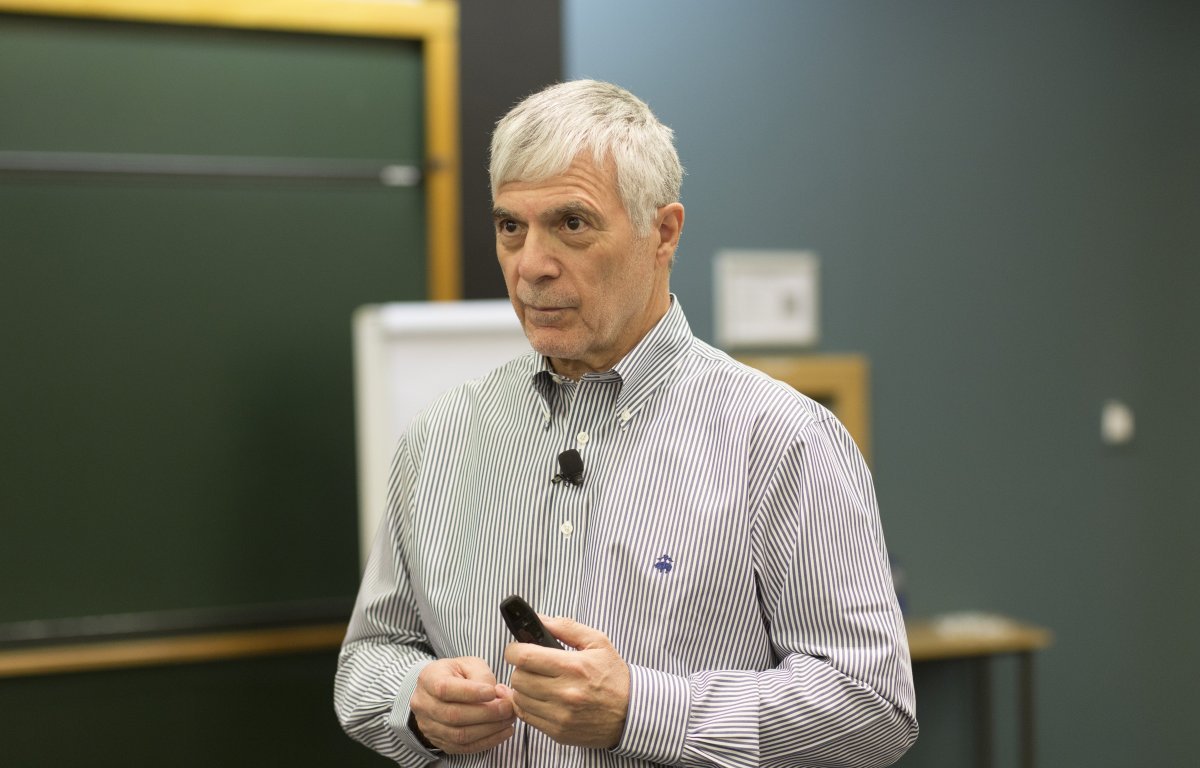
Business strategist Dr. Norman Chorn, a long-time member of GIBS’s international faculty, has some suggestions. Chorn merges the principles of neuroscience and effective strategy with futures thinking. He uses this unique combination to help leaders shape successful businesses during times of change. Chorn also presents GIBS’s popular six-week online course, Strategic Organisational Resilience.
“To me, the strategy for the future is the ability to navigate multiple scenarios, because you can’t predict the future,” says Chorn. What you can do is plan strategically for various alternative future scenarios, which is where resilience comes into the mix. After all, he says, “you can’t have one without the other”.
In practice, this means that when things are uncertain, companies and their leaders should be in a continuous cycle of planning, adapting and changing.
What exactly does corporate resilience look like?
During the turbulent Covid years, Chorn’s BrainLink Group forged ahead with a project devised in 2019 to understand what resilience looked like in strategy terms. “The concept of getting up when you are knocked down, sort of like a spring, didn’t make sense in a corporate environment,” Chorn told Acumen. “If you knock a business over, you lose IP and you lose people, and often the business folds,” he said, citing the 2002 collapse of Australia’s Ansett Airline – the major competitor to Qantas – due to a toxic combination of management blunders, boardroom missteps, and policy uncertainty.
After hundreds of hours spent sitting in on management and executive discussions around the world, plus the odd board meeting, Chorn was able to distil corporate resilience down to three drivers: developing “elastic” thinking; a willingness to explore alternative futures; and learning to practise fluidity in both personal and professional interactions. Chorn advocates challenging closely held mental models, improving how we spot and make sense of shifts on the horizon, and reconfiguring organisations to think in terms of multiple scenarios before selecting the best direction for the business.
Up until two years ago, this was the Chorn playbook for creating internal resilience. Now a fourth element is in play: the use of AI as an amplifier of resilience.
“AI needs to be viewed not as a tool, but as a sort of collaborative partner to leadership and management,” believes Chorn. He argues that AI has the potential to help organisations identify missing internal connections and speed up networks within companies, keeping them lithe and adaptable. Rewiring changes how information flows through a business and improves the effectiveness of the entire organisational ecosystem in the process.
This connected, systems mindset is the real secret to organisational resilience. Like bees in a hive, it’s about working in unison, rather than pulling against one another.
Reconfigure to thrive, not just survive
Chorn believes the starting point on this reconfiguration journey is to worry less about the strategy you have in place, and whether it’s up to the changeable task at hand, and more on the range of capabilities and healthy connections within an organisation. These are the building blocks you need to count on for the future.
It’s all well and good to conduct a rigorous SWOT analysis, and to keep abreast of all sorts of geopolitical machinations, but these are not always the salient issues affecting your company. Being able to discern the difference between noise and relevant threats and opportunities is key for determining the future direction of your business. “What businesses need to focus on is how their markets, their consumers and their supply lines might be changing,” says Chorn. “Those are often changing differently to what geopolitical forces are shaping.”
This sort of approach might be challenging to pull off, but it ultimately builds more resilient individuals and cements adaptability into organisational structures. The strategic win is when all the parts of an organisation have been reconfigured and connected in a way that supports adaptability.
Consider Johannesburg-based telecoms group MTN. Like many emerging market businesses, MTN’s entrepreneurial culture has served the group and its leaders well as they’ve assembled and reassembled their business plans over the years – all the while keeping a beady eye out for new opportunities. As a result of MTN’s strong shift towards mobile money, as part of its Ambition 2025 and Beyond 2025 strategies, the group had to internally reconfigure its thinking beyond being a telecommunications provider to a fully-fledged platform ecosystem spanning the various markets it serves. “If they wanted to take mobile money into a specific country in Africa, they needed to get into the infrastructure and ecosystem game. This was a complete shift,” says Chorn.
Not every company has to reconfigure and reconnect at the same scale, although Chorn points out that MTN is a great example of getting this right. Smaller or medium-sized businesses can achieve the same, simply by shaking things up a bit and adopting the same systems focus.
To illustrate this, Chorn lays out a scenario in which a company incorporates its finance team into an existing business unit. In doing so, they begin to identify as part of the customer-facing business unit, he explains. Ultimately, this reconnects them to the overall business.
This example doesn’t equate to disbanding the finance department, he hastens to add, but by rewiring the internal connections in this manner it is possible to draw a shared-service facility into the business by changing its focus and role. By shifting the internal barriers to engagement, it is possible to create new neural connections within a system or company, and support resilience.
Chorn is the first to admit that such an approach requires a strong willingness at a senior level to embrace fresh ways of thinking or even new technologies like AI to help reorientate the business. For organisations stuck in an operational control and optimisation mindset, these shifts will be harder – but not impossible.
“Don’t wait, apologise later,” is Chorn’s advice to leaders struggling to take the first step. “Don’t break company policy, but do try things.”
After all, in a world of uncertainty the future favours fluidity.
Can culture be an anti-fragile competency?
With experience working with organisations in Africa, Southeast Asia and China, the United Kingdom, Australia, and New Zealand, Dr. Norman Chorn has the advantage of seeing how different cultures respond in the face of uncertainty. Some fold, some dither, and others thrive.
China and many of the Eastern cultures are a case in point. As China’s President Xi Jinping recently noted during a meeting with British Prime Minister Sir Keir Starmer, “In China, we say: ‘One should range far your eye over long vistas.’ As long as we take a broad perspective, rise above differences and respect each other, then we will prove ourselves able to stand the test of history.”
Reflecting on a conversation he had with the GIBS founding Dean, Prof. Nick Binedell, many years ago, Chorn explains that in countries with fewer natural advantages and resources, the need for pragmatism is more entrenched than in regions gifted with abundance. “In China, one of Mao Zedong’s strongest sort of philosophies was that man conquers nature. The role man had, in his view, was actually to not accept the natural environment as it was, but to make it into one that should be. I’ve been to China 30-odd times, and what’s interesting is that they don’t understand natural beauty. They understand built environment beauty.”
This gives China a more pragmatic outlook than the structured Western approach. “I do think that the Eastern cultures seem to be more accepting of this need to rapidly adjust and rapidly orientate all the time, and the fact that their job is to actually master control, to conquer this environment, rather than to live with it and roll with the punches,” says Chorn.
It’s this mindset that has seen China radically shift its internal governance structures over the past 30 years, fight back against desertification with a massive reforestation programme, and push high-tech adoption. “Within the space of about 18 months, they converted every single petrol-driven scooter to batteries. I remember thinking how amazing it was. Now, you don’t see any taxis on the road that aren’t electric. That’s man conquering nature in a lot of ways,” says Chorn, referencing China’s multi-pronged effort to shift towards electric bikes and transport using a combination of city-wide bans, insurance hikes, and cash incentives. “I don’t think we do that so well in the West.”
The crux of the matter
- Levels of global uncertainty are not going down. They are ramping up.
- This means companies need to plan for a range of possible future scenarios – rather than banking on a single strategy.
- This adaptable approach is underpinned by four drivers: elastic thinking, a futures orientation, personal and professional fluidity, and – more recently – a willingness to harness technologies such as artificial intelligence as a thinking partner.
- How different cultures and companies choose to confront today’s challenges will shape their long-term trajectories – providing ample fodder for business schools to dissect in the process.


Gallery