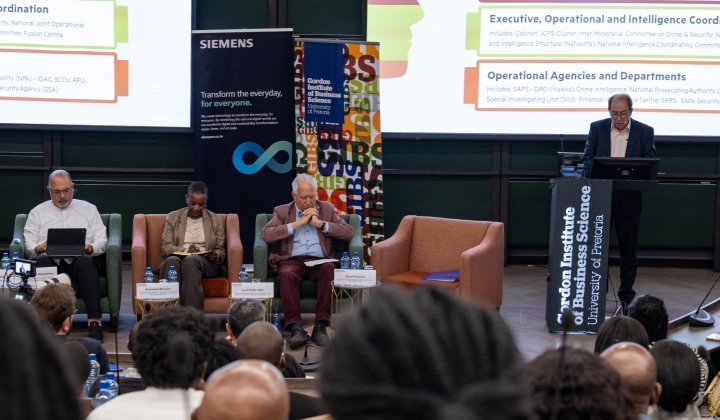
Research coming out of the Global North, while relevant, does not always capture the nuances of local business and leadership challenges. This is one of the reasons that GIBS prioritises research. We are actively looking to contribute meaningfully to the understanding of the local business environment and ecosystem, through rigorous, peer-reviewed research. When this research is published in international journals, it exposes African insights to the global business community.
Attributional Sense‐Making of Distrust in Professional Service Firms: Working in a Coopetitive Paradox
Authors: Neve Abgeller, Mark Saunders, Rory Donnelly, and Tony Dobbins
Journal: Journal of Occupational and Organizational Psychology (UK)
Link: https://bpspsychub.onlinelibrary.wiley.com/doi/pdfdirect/10.1111/joop.70086 (free to view)
Distrust can have an impact on the business’s reputation, bottom line, and ultimately its long-term sustainability. This research focuses on professional service firms, which provide a useful lens to study the concept of distrust because they combine intense collaboration with fierce competition, making potential dynamics of distrust easier to observe, says University of Birmingham Professor Mark Saunders. He adds, “By studying them, we gain insights that apply broadly. In particular, small ambiguities in actions and communications can easily be misread as self-interest and therefore become harder to deal with. That’s a universal business challenge, whether you’re in law, tech, healthcare, or a start-up.”
Key findings
The study shows distrust arises from three main sources:
- How people’s motives are interpreted
- The signals received from organisational structures and culture
- The everyday interactions experienced
The key finding, says Saunders, is “braided attributions”, that is, the way these explanations get woven together. A minor mistake in wording or an unclear decision can quickly develop into a narrative of suspicion, reinforced by systemic pressures, and workplace norms.
Research in practice
Saunders says, “The key lesson is that distrust isn’t just about individuals; it’s also about systems and structures.” He notes that organisations can reduce distrust by making performance rewards more transparent, improving communication, and designing policies that balance competition with fairness. Even small tweaks like consistent feedback or clear recognition practices can reduce the likelihood of distrust becoming entrenched.
Who should be reading this research?
This research isn’t just for consultants. It is relevant to all leaders in any competitive, high-pressure environment. Internally, teams can also use these insights to design healthier cultures where collaboration isn’t undermined by suspicion.
Managing Open Strategy in Public-Private Sector Business Model Innovation: Closing to Open and Opening to Close as Intertemporal Dualities
Authors: John Nicholson, Philip Coombes, and Adam Lindgreen
Journal: Long Range Planning (EU)
Link: https://shura.shu.ac.uk/36692/1/Longe%20Range%20Planning%20v7%20%28accepted%20version%29.pdf (free to view)
Organisations increasingly face the strategic question of how open (transparent and inclusive) or closed (secretive and exclusive) they should be when collaborating, particularly in public–private partnerships. Adam Lindgreen, full professor of marketing at the Copenhagen Business School and GIBS extraordinary professor, explains, “The study examines how ‘ideal’ strategic openness emerges in business model innovation and how organisations manage tensions between openness and closure over time.”
Key findings
The research revealed a number of key insights around how a public–private business model emerged through opening and closing collaboration through time, and then enabled opposite dynamics later. Some key insights include:
- National policy changes encouraged collaboration between public and private sectors, allowing local partnerships to develop new service models.
- Strategic openness enabled joint facility design, while selective closure occurred around geographic boundaries and the appointment of a primary contractor.
- Transparency in risk-sharing and long-term contracts supported value capture while encouraging broader participation in value creation.
- Over time, adaptive practices, relational collaboration, and local supplier involvement generated regional economic benefits and refined the business model.
Research in practice
In practice, a key contribution is the proposal to broaden the idea of a “practitioner” by introducing the concept of protagonists, who are important actors supporting open participation in public-sector business models. These protagonists extend beyond typical roles such as orchestrators, customers, or complementors to include influential community stakeholders. Lindgreen says, “Their involvement can shape how firms and even competitors engage with the business model and contribute to collaborative value creation within the partnership.” He adds that the research also offers a novel framework to academics because it advances understanding of open strategy by conceptualising openness and closure as intertemporal dualities.
Who should be reading this research?
This research is important for anyone involved in collaborative partnerships, including private and public sector leaders, policy makers, and academics.
How to Shape Internationalisation: Footprint Configurations of Knowledge-Intensive Service Firms
Authors: Rany Salvoldi and David Brock
Journal: International Business Review (UK)
Link: https://doi.org/10.1016/j.ibusrev.2025.102531
Many knowledge intensive service firms – like law firms, consultancies, and other professional services – struggle with a basic question, “How international should we really be?” Conventional wisdom often says “stay close to home” because these firms rely heavily on local knowledge, relationships, and institutions. But at the same time, their clients are becoming more global and complex. David Brock, GIBS research associate and faculty member, says, “This research matters because it moves beyond the unhelpful question of ‘how much internationalisation is best?’ to rather ask how international footprints are put together. By showing that different international setups can all work – if they are designed thoughtfully – the study offers a much more realistic and useful way of thinking about global expansion for service firms.”
Key findings
- The most striking finding, according to Brock, is that there is no single “right” level of internationalisation.
- What matters more than how many offices there are, is the location of those offices.
- Firms that operate across different legal and institutional systems tend to be evaluated more positively by clients.
- Even firms with a very small international footprint benefit if that footprint exposes them to genuinely different ways of doing business.
- An emphasis on institutional variety is more important than geographic spread.
Research in practice
Brock believes the research has real practical value and says, “The message is clear: internationalisation should be a design problem, not a numbers game. Opening one or two offices in the ‘right’ places can be more valuable than opening many offices in similar markets.” He urges firms to think carefully about what their international presence signals to clients about their ability to handle complex, cross-border problems, rather than simply aiming to look global.
Who should read this research?
This research will be most useful for leaders of professional service and knowledge-based firms, strategy teams considering international expansion, and policymakers interested in how services globalise.
Understanding Customer Grief in Brand Relationships
Authors: Adele Berndt and Kieran Tierney
Journal: Journal of Business Research (EU)
Link: https://www.sciencedirect.com/science/article/pii/S0148296325005818
Brands play an important role in people’s everyday lives, and customers build strong and sometimes deeply emotional relationships with their preferred branded products. GIBS research associate Adele Berndt says, “However, companies often change or discontinue products without thinking how their actions impact customers relationship with, and their emotions toward, the brand. When this happens, customers can react negatively.” She explains that the outcome is often the reaction of grief, which is a deeply emotional response that includes anger, sadness, frustration, and a sense of loss.
Key findings
The study focused on the removal of Kellogg’s Rice Krispies in South Africa (2018/2019). Berndt says, “While grocery products are often seen as mundane and customers perhaps not so attached to them, we were surprised by the intensity of customers’ reactions.”
The study revealed that many people expressed strong emotions online, particularly on social media. Customers shared their frustration and anger, begged for the product to return in its original form, and described feeling abandoned by the brand. “The depth and visibility of these responses highlighted how meaningful even everyday brands can be,” says Berndt.
Research in practice
Grief is usually associated with losing a person, but our research shows that people can also experience grief when they lose a favourite brand. Berndt says, “Managers need to know that removing or changing a brand can trigger strong emotional responses, leading customers to switch to competitors, disengage entirely, or respond negatively toward the company, even considering forms of revenge.” Understanding this can help organisations make more informed decisions to better manage change and communicate this more effectively. She adds, “In today’s digital world, customer reactions are highly visible and can spread quickly, causing an online firestorm that negatively shapes brand reputation.”
Who should be reading this research?
This research is relevant for managers and anyone making product-related decisions.
Book Chapter
From Sterile Labs to Societal Playgrounds: Classrooms as Spaces for Dignity
Author: Dr. Roze Phillips
Book: Elgar Companion to Management Education and the Sustainable Development Goals (RSA)
Link: https://www.elgaronline.com/edcollchap-oa/book/9781035337170/chapter18.xml (free to view)
Classrooms don’t just transfer knowledge; they shape how future leaders see the world. Beyond the classroom, organisations are the “live” classrooms where these worldviews are reinforced or reimagined and both classrooms and businesses shape leadership. Dr. Roze Phillips, GIBS adjunct faculty, says, “In South Africa, where business is inseparable from social and environmental realities, this matters. We often treat classrooms as neutral spaces. They’re not. If we reimagine classrooms as spaces of dignity linked to society, we aren't just improving education, we are shaping leaders who are attuned to complexity, inequality, and long-term economic and social impact.”
Key findings
- The big takeaway is that students don’t want to be passive. They want to engage with real-world problems, not just classroom-based case studies or lectures.
- Students want classrooms that are bridges into society, not escape routes from it, where learning extends beyond simulation. The Jukskei River Revitalisation Project is an example of how the classroom brings the idea of dignity to life for both people and planet as something you can actually design into systems and decisions.
Research in practice
By shifting from ego-systemic (self-centric) to ecosystemic thinking, we want to build adaptive leaders in classrooms and boardrooms who can navigate uncertainty. They need to start imagining alternative futures where profitability is linked to the health of the systems they inhabit. Phillips says, “The four stages of regenerative futures provides the roadmap to move beyond ‘doing less harm’ toward ‘enabling the most good’ so that business and societies can flourish together.”
Who should be reading this research?
This research is for educators, but equally business leaders, board members, and anyone involved in strategy, talent, and sustainability. Ultimately, this is about the kind of leadership and organisational entities we are cultivating.
Case Study
Nampak – Strategic Turnaround Leadership
Authors: Charlene Lew and Mark Lamberti
Publication: Emerald Emerging Markets Case Studies (UK)
Link: http://doi.org/10.1108/EEMCS-08-2025-0480
As a case study, this research focuses on a single company. While it does not provide a generalised view on strategic turnaround, it offers leaders a chance to learn how to tackle large-scale strategic change and reflect on their own approaches. The case is used alongside an instructor’s teaching note to help unpack the answers to these reflections. GIBS’ Professor Charlene Lew says, “This case study offers readers the opportunity to consider the best approaches to implementing substantial strategic change in an organisation.”
Key findings
- The first finding from the literature and Nampak’s experience is that turnaround strategy requires doing things in ways that are not always enjoyable or congenial.
- Another key outcome is the need for a clear philosophy and a focused strategy. Phil Roux, then-CEO of Nampak, kept a laminated one-page document of his philosophy and approach close at all times. This guided all strategic decisions and actions.
- A good turnaround strategist is clear about several distinct priorities: strategic, people-related, operational, and financial. The turnaround team needs to plan and implement all these priorities simultaneously.
Research in practice
Lew says that corporate trauma can result in legacies that prevent successful turnaround attempts. She says that practically, sometimes the only solution is to let go of the people who were part of the trauma, or turnaround efforts will not succeed. Mark Lamberti, reflecting on the lessons learned, emphasises the need for radical financial analysis, clarity on priorities, and the courage to timeously make and implement far-reaching decisions. He says, “Many can see the deterioration of major performance metrics, but they either lack the acumen to identify and rectify the underlying causes, or they hesitate when decisiveness may be the key to survival.”
Who should be reading this research?
While this case was written as a teaching case for the classroom context, any leader interested in learning about a successful strategic turnaround leader and how he transformed a company would find this case study beneficial.