
While Communications Minister Solly Malatsi was quick to act, rapidly withdrawing the document from public comment, he admitted that “this failure is not a mere technical issue but has compromised the integrity and credibility of the draft policy”.
Certainly, it’s not only the algorithm’s shortcomings that require scrutiny, but the ethics around appropriate human use of artificial intelligence (AI) and the guardrails needed to ensure that issues of bias and prejudice are not allowed to flourish in a world where algorithms increasingly set the tone.
What makes Malatsi’s about-face so notable is that it strikes at the heart of governance and trust in policymaking exactly at the time when clearly thought-out parameters for AI engagement are so essential. Outsourcing the rulebook for legal, economic, social, and democratic engagement to an emerging technology is worrying enough, but in the African context it is more concerning given clear evidence of racial and gender bias in AI coding.
If AI bias is already evident across critical sectors such as healthcare, police profiling, wage gap discrimination, education, and scientific research, then what do we stand to lose as a continent if we simply slot into dominant global AI frameworks without fully interrogating the issue of ethics?
Context matters more than ever
As a country which is still, in many respects, entrenched in the apartheid legacy, we must be extremely careful from a bias perspective of how and on what data our AI tools are trained. We already know that using AI algorithms trained on historical data is directly affecting marginalised groups in terms of employment and career advancement, undoing previous advancements made by women, racial minorities, and people with disabilities.
We have to ask ourselves, therefore, what biases we are embedding if the AIs we use are trained on pre-1994 data. Similarly, if we discount pre-1994 sources, then we discount our history which, no matter how painful, is still a fundamental part of our cultural identity, legacy, collective mindset, and national worldview. Yet, homogenising our complexity and our uniqueness is exactly the risk AI bias poses.
Just like its human variant, the bias displayed by AI platforms is not necessarily part of a Machiavellian conspiracy. Sometimes it’s just based on the input we’ve been fed. Fortunately we know that if you change the input, you can shift perceptions.
If we consider that AI bias is, at its simplest definition, a systematic error in AI output that produces either fear or discriminatory outcomes, then the raw materials we feed into these programs are critical. This turns the discussion to the building blocks of AI foundations, how models are trained and integrated, and how human oversight is exercised. Each of these ethical considerations is critical to ensuring that AI does not take existing human discrimination, ramp it up and industrialise it at scale. Unfortunately, this is not what we are seeing in the marketplace. As the authors of a joint Britain-American research article note, the bias shown by popular AI platforms like ChatGPT reflect a similar “silicon gaze” when it comes to regions like Africa, Asia, Latin America, and the Middle East. This has the effect of reinforcing “deep-seated inequalities across scales of place and categories of knowledge”. The authors call for greater transparency from developers and organisational users of AI around algorithms and frameworks, and stronger policy responses to “prevent today’s platformised models from hard-coding yesterday’s hierarchies into tomorrow’s decisions”.
Who is pressing the buttons?
The models in question are, of course, being built by a handful of dominant players: the United States, China, India, South Korea, the United Kingdom, United Arab Emirates, Japan, and Canada. Africa barely features, which means we are simply using big global models such as Claude, Gemini, CoPilot, and ChatGPT. In the process we are taking on board their built-in biases.
It’s not all doom and gloom. There are positives on the horizon, such as Africa-made AI products. Vulavula by Lelapa AI, for instance, gives us a very good idea of what a truly contextual AI system looks like. However, it’s impossible to get away from the fact that Africa is part of a global system and the big platforms have extraordinary reach, so matching them for control and ownership will be hard. Fortunately, collaboration has a role to play in combatting algorithm bias.
Working closely with global partners, ensuring we have strong and credible policies and enforcement of standards in place, and supporting our own software industries will determine how we approach a future that will inevitably involve AI products and services.
This is where the guardrails come in.
Rules and regulations
As Zimbabwean researchers Notice Pasipamire and Abton Muroyiwa explain, AI can help African countries achieve vital United Nations sustainable development goals (SDGs). However, stamping out AI bias and ensuring inclusivity are critical if fairness and equality remain ingrained in the achievement of these targets. Getting to this point, explain Pasipamire and Muroyiwa, requires AI platforms, developers, and policymakers to “collaborate to create more inclusive and equitable algorithms” that are trained on data that includes information from underrepresented or historically marginalised groups, and which confirm to clear pan-African regulatory frameworks.
While the African Union has already published a continental AI strategy that embraces the use of AI to help achieve SDGs, while fuelling innovation and creating jobs, there are interesting regulatory developments around the world that highlight some of the fast-moving shifts taking place.
In the US, for instance, there is a strong push for keeping humans in the loop and ensuring organisations are held accountable for biased or exclusionary outcomes produced by algorithms. However, political faultlines are now emerging, with the Trump administration signalling an intent to consolidate AI oversight at the federal level rather than the current patchwork of state-determined AI rules. Arriving at national standards means, in effect, that minimal burdens and standards will be promoted across the entire US, effectively settling on the lowest common denominator. Since US-built models and AIs are being pushed out globally at a rapid rate, the potential for reduced oversight and ingrained bias is worrying.
In contrast to the US’s “innovation first” approach, the European Union (EU) has opted for a tiered risk-based tactic. From August 2026, the EU’s AI Act will become the first wide-ranging legal framework to be imposed on AI technologies and will require stricter compliance for higher-risk sectors like hiring, credit, healthcare, and law enforcement, using tough financial penalties as a big stick.
Given South Africa’s tendency to follow the example set by European lawmakers, it will be interesting to see how this unfolds over the next year. Equally, the first major autonomous AI failure – when it inevitably happens – will also set liability precedents, while judicial rulings around issues of copyright for AI-authored work will shape the regulatory response.
All of these balls currently up in the air do, however, point us towards one big question: where does the buck stop in the event of an AI causing harm?
Does responsibility rest with the developer, the deployer, or the employee operating the system? Right now, it’s a grey area and until we achieve more clarity around accountability, autonomous AI systems will continue to operate without firm red lines to keep deep-seated racial and algorithmic bias out of AI codes. Right now, there is everything to play for and so much to lose.
How is AI bias hurting you?
When someone is prejudiced by a decision that a machine has made, leading to an unfair output, that’s bias in action. Right now, there are five primary areas where the data points used to build AI systems are already impacting lives and careers.
- Facial recognition: In 2016, a Master’s thesis by MIT graduate Dr Joy Buolamwini gave rise to the Gender Shades Project, an initiative that highlights how commercial AI facial recognition tools are more accurate on light-skinned men and make more errors on dark-skinned females. Buolamwini showed that machine learning algorithms can – and do – discriminate on the basis of race and gender. In a world where facial recognition is being rolled out to facilitate more streamlined border control and law enforcement, this poses a risk to those affected by these in-built biases.
- Healthcare: Concerns around potential bias against darker-skinned individuals by AI-driven healthcare tools is a significant issue. Patients with darker skin tones are often flagged as being healthier than they are, not because of the colour of their skin but because models are built based on healthcare spending rather than clinical outcomes. Historically, black patients have spent less on healthcare than their white counterparts, so using these indicators to build algorithms threatens to perpetuate past exclusions in an increasingly multi-cultural world.
- Employment: In the US, a case is currently before the courts against Workday, which uses an AI-driven applicant screening system to vet job applications. The contention is that the algorithm discriminates against applicants older than 40. Similarly, tutoring firm iTutorGroup agreed in 2023 to financially compensate more than 200 job hopefuls whose applications were rejected by an AI trained to exclude women older than 55 and men above 60.
- Access to credit: Reliance on data from social media feeds and browsing history has been linked to biased outcomes by digital lending apps in Kenya, while credit scores for women in Africa are negatively impacted due to limited connectivity and associated digital footprints. Similarly, Zimbabwean researchers note that “loan repayment prediction algorithms exhibit gender bias, resulting in lower approval rates for female borrowers” in Africa.
The core concern
- AI failings – like South Africa’s rapid withdrawal of the draft national artificial intelligence policy – are a reflection of human ethical shortcomings.
- When used wisely, AI technologies can be harnessed to shine a light on our own ethical failings.
- When used recklessly or without clear parameters, we run the risk of exacerbating inequality and ingrained bias.
- While governance typically lags new innovations by three to five years, the gap in AI regulation comes at a time when AI uptake is surging globally, and the stakes are at their highest.
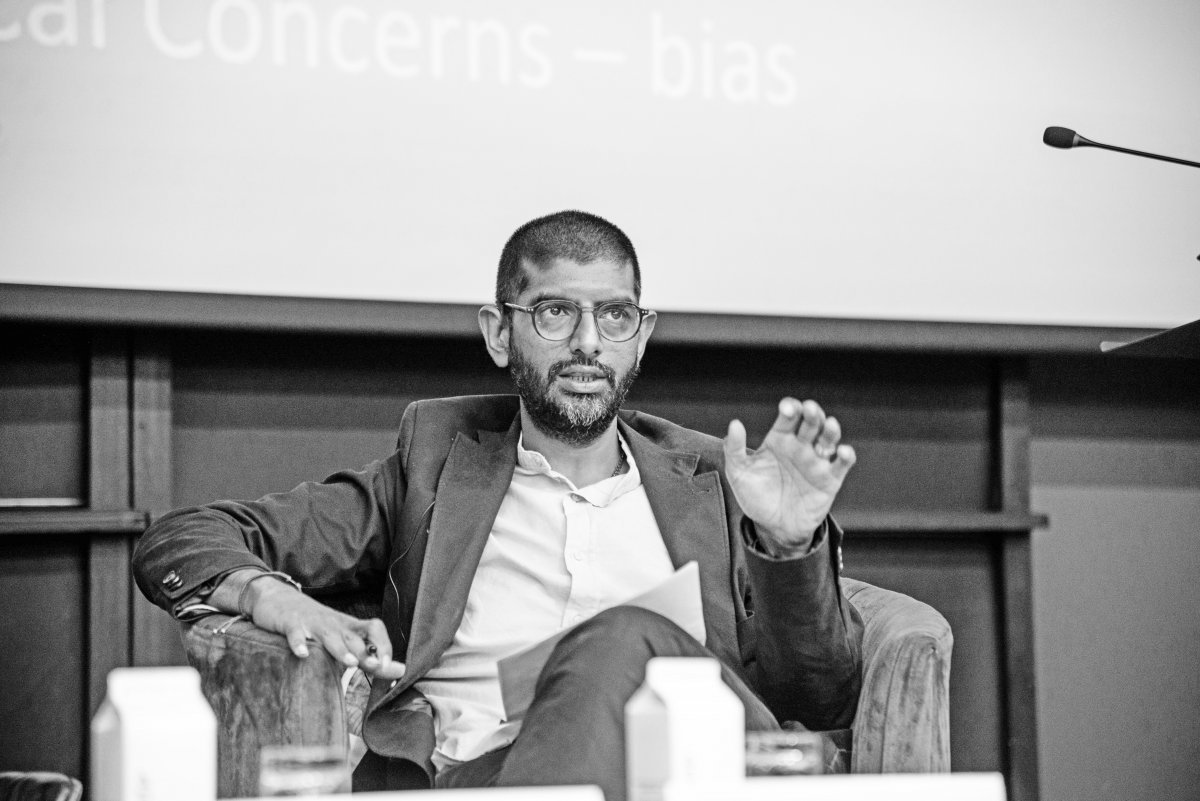
Professor Manoj Chiba is the MBA director at GIBS. An associate professor and lead faculty for innovation and design, Chiba lectures on research, statistics, predictive analytics, digitisation, intersection of business, society and technology, and artificial intelligence. He also supervises MBA and PhD theses in the fields of international business strategy and structure, data and strategy, digital business models, and innovation. As a management professional, Chiba has held senior positions across different sectors.


Gallery