
One MBA graduate’s journey from property developer to social infrastructure investor reveals how partnerships, alternative funding and a deep understanding of underserved markets can unlock both commercial growth and meaningful social impact.
The journey from Musina to Polokwane takes more than two and a half hours. For Mpho Khorombi, that drive became all too familiar as he took his pregnant wife to access private healthcare unavailable closer to home.
What began as a personal challenge revealed a much larger gap. Khorombi saw that the shortcomings in social infrastructure extended far beyond student accommodation and affordable housing. Healthcare, too, remained out of reach for many people living in underserved parts of South Africa.
But while many investors chase premium developments, some entrepreneurs are finding opportunity in places overlooked by traditional capital.
For Khorombi, a GIBS MBA and independent property entrepreneur and developer, the long drive to Polokwane marked a turning point. “This experience was deeply personal and that’s when I realised I needed to invest in social infrastructure because of the greater need and demand,” he says.
In property development, social infrastructure refers to the facilities and services that support communities and improve quality of life. These include student accommodation, affordable housing, healthcare facilities, shopping centres and public transport networks. In underserved markets, they are not only essential services but also opportunities to create lasting social and economic impact.
Building more than property
Entrepreneurship came naturally to Khorombi. Growing up, he was always looking for ways to generate income, from selling bunny chow at school to supplying branded T-shirts to mining students at the University of Johannesburg and the University of the Witwatersrand, while also running an audio-visual hire company.
After qualifying as a mining engineer and working at a gold mine, he realised his entrepreneurial ambitions were outgrowing his career. Property offered a path to build something of his own, but it was a visit to his sister at Vaal University of Technology that revealed where the greatest need existed. Witnessing the poor living conditions many students endured sparked his interest in student accommodation.
His first property investment was a R450 000 single-family rental home in Alberton in 2013. However, he quickly realised that this model would not create meaningful scale, prompting a shift towards multi-unit developments. Student accommodation became his entry point into social infrastructure. Working within the Department of Higher Education and Training’s minimum norms and standards, particularly for National Student Financial Aid Scheme-funded (NSFAS) students, taught him how to balance compliance, profitability, and long-term demand. His first development in the Vaal achieved full occupancy on launch day.
The same demand dynamics were evident in affordable housing. In Katlehong, where he grew up, Khorombi developed Sebenzile Lofts, a 21-unit affordable rental development. The units were fully leased on launch day and continue to attract enquiries. “People in underserved communities are not just looking for a place to stay, they want safety, quality design, and dignity,” he says.
These experiences reshaped his view of risk. Markets often overlooked by traditional investors were proving both commercially viable and socially impactful. That realisation ultimately led him to healthcare infrastructure, where unmet demand, despite higher capital and regulatory hurdles, presents another opportunity to create sustainable long-term value while addressing a critical community need.
Seeing opportunity where others see risk
For Khorombi, the decision to focus on social infrastructure came from recognising opportunities in markets many investors overlook. Townships, peri-urban areas, and rural communities are often perceived as high risk, largely because of limited market information and a lack of investment activity. However, his experience in student accommodation and affordable housing tells a different story of strong demand and constrained supply with tenants who are willing to pay for quality developments.
That conviction now underpins his latest venture, the R220 million Musina Private Hospital development on the border of South Africa and Zimbabwe.
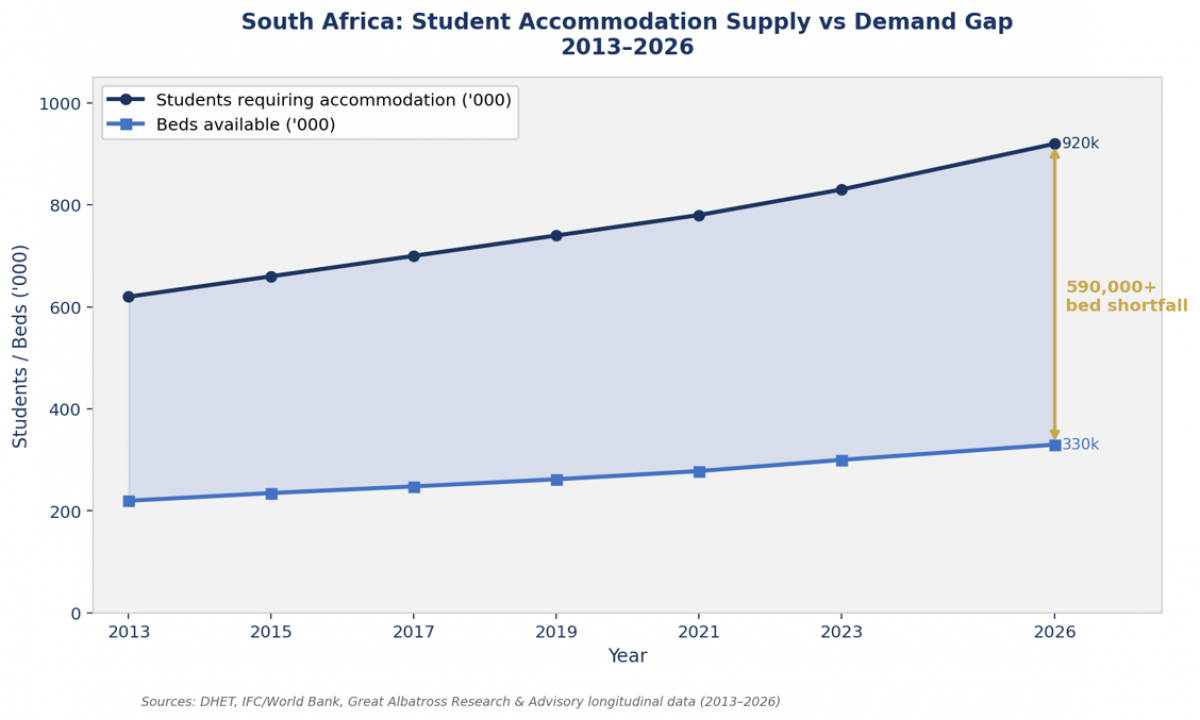
According to Great Albatross Research & Advisory, demand for affordable housing, student accommodation, and healthcare facilities consistently exceeds supply in underserved markets. Longitudinal research tracking the student accommodation sector since 2013 shows the gap between available beds and students requiring off-campus housing has widened year-on-year, with NSFAS funding constraints adding further pressure.
Affordable housing faces similar pressures, while healthcare access remains constrained. In healthcare, access remains limited, with Johannesburg alone relying on just 122 primary healthcare facilities to serve more than five million people.
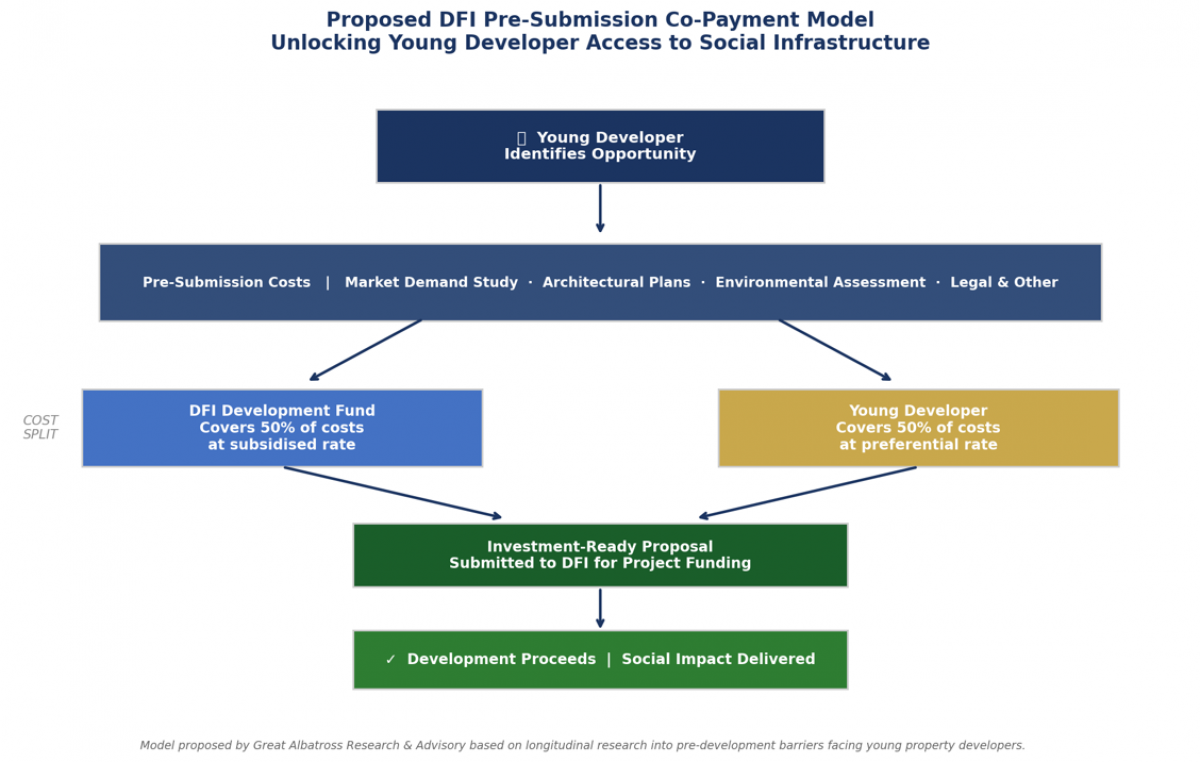
Thubelihle Sithole, director at Great Albatross Research & Advisory, says emerging developers face three challenges: weak demand assumptions, dependence on government funding, and limited pre-development capital.
Ben Kodisang, founder and CEO of ALT Capital Partners, says township, rural, and peri-urban markets remain underestimated despite strong demand and economic activity. “The misconception is that impact compromises returns, when in reality, inclusion can unlock overlooked commercial value.”
Building partnerships for scale
Scaling from developments valued between R10 million and R60 million to a billion-rand pipeline has required more than technical expertise, says Khorombi. Those early projects, combined with formal training in finance, real estate development, and his GIBS MBA, taught him resilience and stakeholder management.
“At scale, the game shifts. It becomes less about individual projects and more about pipeline thinking, access to capital and strong partnerships. Your track record starts to work for you. Opportunities come through reputation and execution credibility. Consistency builds trust, and trust is what unlocks bigger deals.”
That philosophy is useful in his involvement in a public-private partnership with the City of Ekurhuleni for a 14-hectare high-density residential development on municipal land.
Prof. Motshedisi Mathibe, the head of department for business management and entrepreneurship at GIBS, argues that successful entrepreneurs do not simply identify opportunities, they build the ecosystems required to unlock them. Social infrastructure projects rely on collaboration across public and private stakeholders.
“Strategic partnerships enable entrepreneurs to access patient capital, reduce institutional risk, and improve implementation capacity. In many cases, they are what bridge the gap between commercial viability and developmental impact,” she says.
Capital follows confidence
If demand is clear, why do so many social infrastructure projects struggle to get off the ground? According to developers and financiers, the answer often lies in the funding gap between proving a concept and scaling it.
For Khorombi, funding remains one of the biggest barriers to growth. While development finance institutions (DFIs) are often willing to provide senior debt for bankable projects, typically funding 50% to 60% of development costs, securing equity is far more challenging.
“As a sponsor, you are expected to contribute between 20% and 40% equity, which becomes difficult at scale. I’ve addressed this by structuring partnerships across private equity, established developers, and high-net-worth individuals. The key is aligning interests – DFIs seek impact, private equity seeks returns, and both require strong fundamentals.”
The challenge is not unique to Khorombi. Brian Bango, managing director of iSTENA Building Solutions and chairman of the Township Developers Forum in the Western Cape, says limited equity funding continues to constrain affordable housing development. With few financiers operating in the sector, emerging developers often struggle to scale despite growing market demand. Through the forum, public-private partnerships have helped unlock projects that may otherwise have stalled.
Development finance institutions could help unlock growth by co-funding pre-development expenses, enabling more entrepreneurs to turn viable opportunities into investable projects, says Sithole.
According to specialist property financier TUHF’s client coverage executive Velda Derrocks, entrepreneurs are often best positioned to respond to underserved markets but need flexible funding structures to scale.
For George Phiri, GM for lending at the National Housing Finance Corporation (NHFC), successful projects balance developmental impact with financial discipline. “Patient capital, concessionary funding, and fit-for-purpose underwriting can make projects viable while maintaining sustainable returns.”
Funders say the lesson on funding is that capital follows confidence. Entrepreneurs who can demonstrate demand, execution capability, and a viable business model are far more likely to attract the partnerships and funding needed to scale.
Why social infrastructure matters for growth
Since his first investment in 2013, Khorombi has become convinced that some of South Africa’s greatest opportunities lie in addressing social infrastructure backlogs. “Proof of delivery is ultimately what wins you the next deal,” he says.
For investors, the benefits are equally significant. Kodisang argues that successful social infrastructure investment improves access, dignity, and economic participation while creating sustainable long-term value. “Whether through retail centres, housing, or healthcare facilities, these developments bring essential services closer to underserved communities, create jobs, and support local enterprise development.”
According to Sithole, research supports the business case for social infrastructure developments. Well-located student accommodation developments in underserved areas can achieve occupancy rates comparable to, or higher than, those in affluent nodes.
Prof .Mathibe adds that the strength of most successful entrepreneurs lies in solving access challenges through innovative financing, partnerships, and scalable business models.
Taken together, these perspectives point to a broader narrative that social infrastructure is not charity. It is a long-term growth strategy that promotes economic inclusion, supports urbanisation and expands access to education, healthcare, and opportunity.
KEY TAKEAWAYS
Five lessons for entrepreneurs
Khorombi’s advice is to build the pipeline early. While developing one project, identify the next opportunity and pursue multiple investors. Here are his key lessons:
Read. industry reports and biographies of successful entrepreneurs.
Start small and learn. His first 40-bed student accommodation project provided practical lessons in municipal processes, design, and construction. Master the fundamentals before pursuing larger opportunities.
Stay focused. Every entrepreneur faces distractions and tempting alternatives. Choose a niche, commit to it, and keep sight of where you want to be in 10 years’ time.
Hire experienced people. Skilled consultants, engineers, and advisers with proven sector expertise can save both time and money.
Believe before you achieve. Belief comes before ability, he says. “Conviction is what carries you through the tough times and this journey is full of them.”


Gallery