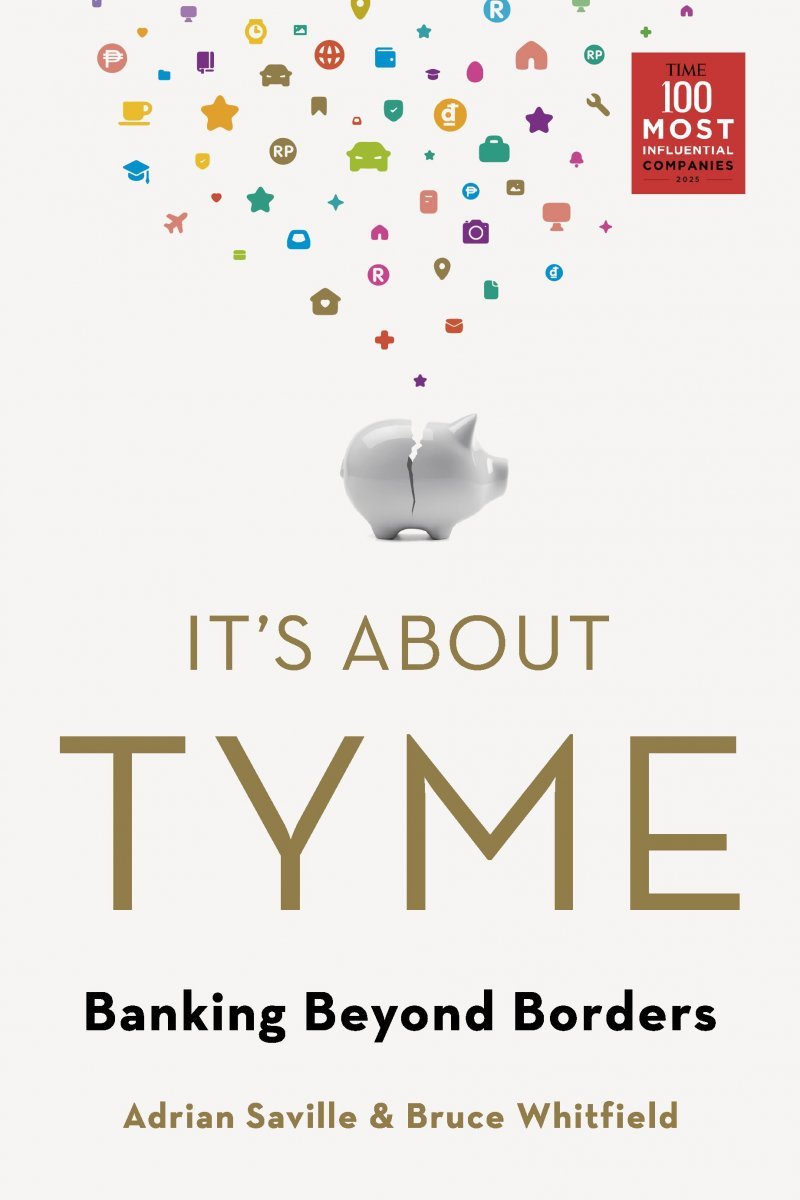

It’s About Tyme: Banking Beyond Borders
Adrian Saville & Bruce Whitfield
Pan Macmillan – R360
It wouldn’t be my normal practice to start a book review with a disclaimer, but in this case it’s necessary. Adrian Saville is, of course, Professor Adrian Saville of GIBS, who has written for Acumen on many occasions. Bruce Whitfield and I worked together for many years at Talk Radio 702 and Cape Talk. I consider both to be friends in the professional sense; we’ll happily share a cup of coffee or a glass of wine, if the occasion presents itself. It’s important also to note that one of their book’s protagonists – Tyme Bank co-founder Coen Jonker – is a GIBS MBA and regularly cited by the business school as a success story.
The two are linked, because Jonker approached Saville and Whitfield in early 2024 to write the book. In a lengthy preface, they explain their decision to accept Jonker’s offer and the fee – presumably a large one – that came with it: “Each of us was busy with new projects and neither of us wanted our reputations as independent thinkers to be sullied by the fact that this would be a paid-for project.”
Well, yes. The problem – and here I speak from personal experience, having done a similar piece of corporate writing some years ago – is that he who pays the piper calls the tune. That remains true no matter how loudly the writer or writers claim to have been given carte blanche to write whatever they find. There are always a final edit and stamp of approval from the person signing the cheque.
Which is a pity, because It’s About Tyme is well written, instructive and a compelling read. If you’ve ever been in the classroom with Adrian Saville or listened to Bruce Whitfield on the radio, you’ll know that both men have an easy charm and a way of making highly complex issues seem simple, always entertaining and sometimes amusing. They bring their skills to bear in this book.
Coen Jonker, it seems, wanted it written to preserve Tyme Bank’s stories of origin which, he admits to the authors, he and his colleagues were in danger of forgetting. Fair enough, so they start at the beginning and the tale runs it chronological course. The opening chapters run through Jonker’s relationship with Tyme Bank co-founder Tjaart van der Walt, his decision to study for an MBA at GIBS, and his time as CEO of SA’s largest law firm, Edward Nathan. That firm was – unhappily – bought by Nedbank and then sold back to its partners, including Jonker.
From there Jonker moves to Standard Bank and into a relationship with MTN, all the while driven by a vision of banking the millions of unbanked, not just in South Africa but across the world. It’s a vision of economic inclusion, inspired by Peruvian economist Hernando de Soto.
Eventually, Jonker goes his own way, which is when Tyme Bank is born and he can begin to fulfil that vision, first in this country and then, somewhat amazingly, in the Philippines and latterly in Indonesia. There are the predictable near-financial-death experiences, overcome with dogged perseverance and a slice or two of sheer good luck.
The book is lacking in two respects.
First, we don’t get close enough to Coen Jonker, the man. What’s he like as a person? Around a braai? Does he watch rugby or soccer? Drink beer or wine or nothing at all? These are the kind of details we’re missing.
Second, if this is a book about economic inclusion and banking the unbanked, another major story unfolds in parallel as Jonker starts his journey: Capitec. Now South Africa’s largest bank by customer base and built on a very different model from Tyme Bank, Capitec is many times the size of Jonker’s enterprise – at least for the time being. But it is certainly fostering economic inclusion and surely an analysis of Tyme Bank’s success would require deep comparison with that of Capitec. Yet Capitec receives no more than a glancing mention or two from the authors.
Which brings me back to my original concern: is the lack of personal details about Jonker and the near exclusion of Capitec a choice made by Saville and Whitfield? Or was it forced on them by the man who paid them to write the book?
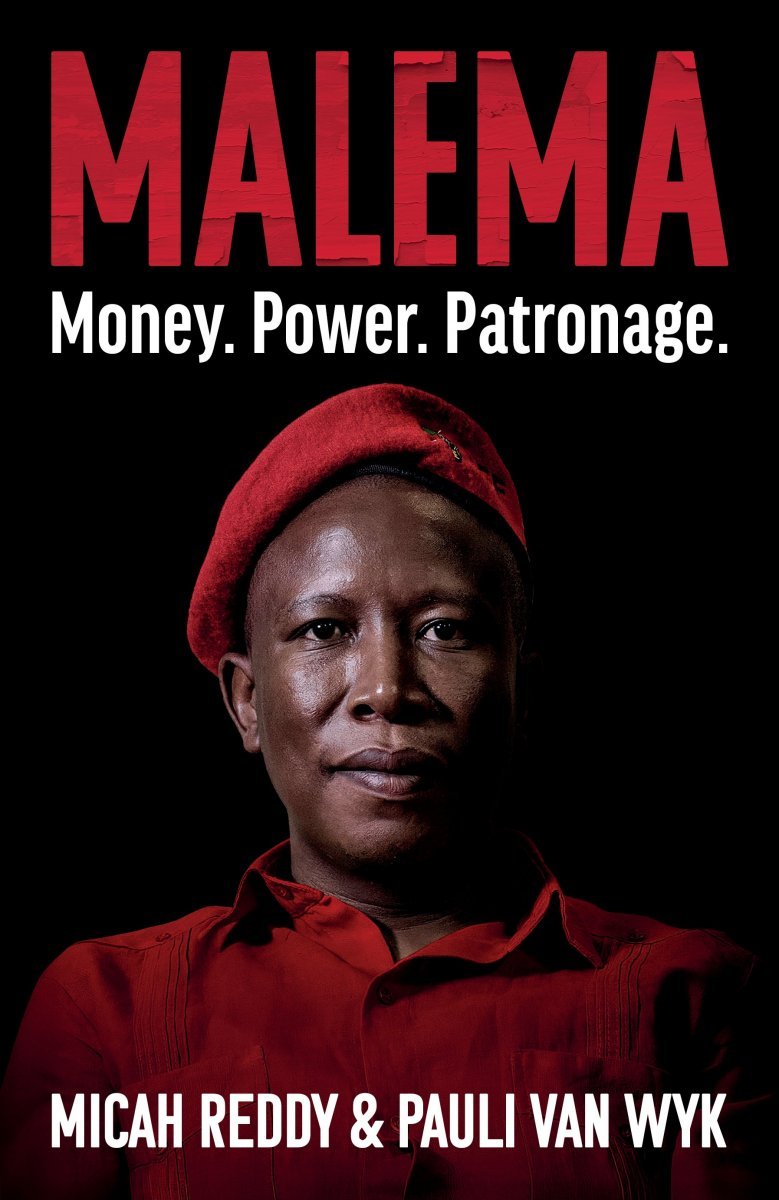
Malema: Money. Power. Patronage
Micah Reddy & Pauli van Wyk
Tafelberg – R360
Is Julius Malema a crook, thief, liar, rogue, or just a brilliant politician and hero of the people? He may be one or all those things or none of them and I have no doubt that you will have your own opinion on those questions. Two things are indisputable, though. Malema has risen to national prominence and a remarkable degree of power with considerable speed. Along the way he has amassed an equally considerable personal fortune.
Investigative journalists Reddy and Van Wyk examine how these have happened and how the two are intertwined.
Malema’s roots go back to Limpopo, where he grew up. That’s also where his first interactions with the provincial government come into focus along with a company called On-Point Engineering. Limpopo is also where, some years later, we see the collapse of VBS Mutual Bank, looted to destruction by its own top management. The allegations against Malema suggest that he benefited directly from kickbacks paid to On-Point for civil engineering tenders from Limpopo and that monies from VBS were also channelled to him, as well as EFF co-founder Floyd Shivambu.
I must stress that these are allegations, never proven in a court of law, and Malema has always strenuously denied them. There is proof that Shivambu received one relatively small payment of R180 000 from the VBS spoils but nothing more.
And that’s rather the point of Reddy and Van Wyk’s work. They analyse in forensic detail how money courses through South African politics, how tenderpreneurs operate and how little work is actually carried out in the public sphere for billions of lost rand. As importantly, they draw a detailed map of how self-styled radical leaders exploit valid grievances about inequality to enrich themselves, stealing from the very people they claim to fight for.
So where do Malema’s millions come from? Certainly not from his parliamentary salary and it does seem unusual that so many friends and family simply want to donate money to him. Read the book and draw your own conclusions.
If you are in business in this country, though, and at any point encounter government at national, provincial or even local level, you can also read this as a cautionary primer. This is how the system works, these are the warning signs, and this is also why what’s loosely called “service delivery” is collapsing. It’s also why the sale of very high-end Italian and German motor cars is booming.


Gallery