
Often, I am asked why I blend storytelling with business science in my teaching. The answer lies in the profound impact that stories and narratives have on shaping insightful, empathetic, and innovative leaders.
In business education, storytelling not only makes abstract concepts relatable but also cultivates compassionate leadership and drives innovative thinking.
The World Economic Forum’s Future of Jobs Report 2025 detailed the shifting expectations and new skill requirements for the jobs of the future.
According to the report, future core skills include: analytical thinking and innovation; creativity, originality and initiative; and reasoning, problem solving and ideation.
Storytelling can transform the learning experience in business schools in three major ways, namely: making abstract ideas relatable, making good connections, and inspiring innovation and operational excellence.
Compelling stories: Making abstract ideas relatable
Ever wondered why case studies are a big part of the mechanics that are used for teaching in a business school? In his book Leaders Eat Last, author Simon Sinek says, “I know of no case study in history that describes an organisation that has been managed out of a crisis. Every single one of them was led.”
The story of Apple’s rise under Steve Jobs, for example, can elucidate concepts such as product innovation, brand management, and leadership.
When they understand these principles within the context of a compelling story, students can better grasp the nuances of business strategy and execution.
And by weaving these concepts into a narrative, students can see how theories apply in real-life scenarios. This method of teaching helps to clarify not only the “what” and “how” but also the “why” behind business decisions.
Writing in the Harvard Business Review, author Jeff Gothelf explained that storytelling within businesses can “build credibility for yourself and your ideas, inspire an audience, and lead an organisation”.
Stories humanise a perspective and make it real, while giving the audience practical advice and clear direction, empowering them to take action. In order to make storytelling an effective teaching tool, Gothelf advises storytellers to focus on exactly what changes the audience is intended to make.
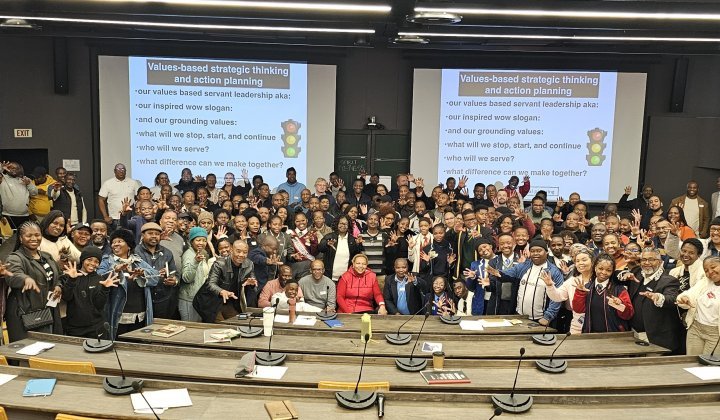
Embracing this approach, at the beginning of March 2025, as part of the Sustainability & ESG: Creating New Strategic Growth programme, I had the pleasure of hosting remarkable guest speakers at our GIBS campus. Enriching our learning journey, they shared invaluable insights and showcased sustainability in an African context, bringing depth to a subject that can sometimes be perceived as abstract.
Joining the conversation of driving strategic growth through ESG, the CEO and co-founder of Everlectric, Ndia Magadagela, shared how the company is shaping the future of electric mobility in South Africa. Everlectric provides electric vehicles as a service, together with cutting-edge charging infrastructure and innovative financing solutions to eliminate barriers to cleaner, more efficient transportation. Their services streamline the transition to electric vehicle fleets, making sustainability more accessible for businesses. To date, the fleet of electric vehicles for this company has travelled 6 500 000 kilometres, all powered by clean energy.
Even more impressively, Everlectric supplies electric panel van vehicles to retail giant Woolworths, for grocery deliveries on selected routes in Gauteng and Cape Town. This initiative highlights the commitment by Woolworths to reducing its carbon footprint and promoting sustainability in the retail industry.
Stories such as that of the partnership between Everlectric and Woolies, when presented to students as business challenges and solutions in a story format, assist facilitators and faculty to turns abstract concepts such as ESG into practical, relatable narratives that bridge the gap between theory and practice.
Impactful stories: Making meaningful connections
Stories that highlight diverse perspectives and experiences can cultivate empathy among students and audiences. This is crucial for developing leaders who are not only effective but also compassionate and socially responsible. More importantly, storytelling in business education contributes to understanding changes and making complex theories accessible.
Stephen Denning in his book The Leader’s Guide to Storytelling: Mastering the Art & Discipline of Business Narrative suggests that there is a strong correlation between storytelling and change management. Furthermore, values and emotions are embodied in the interventions and actions, as well as the stories that are shared about these actions to comprehend their significance.
An impactful example of this idea is author and social entrepreneur Banele Rewo, founder of Z2B Aquaponics Farm in Soweto. Banele turned challenges into opportunities by introducing aquaponics, a system combining fish farming and vegetable cultivation to maximise yields within minimal space in township communities.
To fund the inspiring initiative beyond its eco-friendly approach, he pioneered a novel stokvel-based business model where community members pooled resources to fast-track capital and overcome funding barriers that are faced by entrepreneurs. This venture leveraged community savings and the collective power of small businesses to drive investment and foster collaboration among stakeholders.
Beyond funding, Banele applied principles from his book, Nomayini: The Mentality You Need To Start Any Business, to this novel venture. Moreover, he leveraged social media platforms to share progress, challenges, and milestones, turning digital platforms into hubs for collaboration and investment. His transparency attracted corporate sponsors, local businesses, and government stakeholders, transforming Z2B Aquaponics Farm from a farming project into a movement for food security and economic empowerment.
In a business education context, this story brings Michael Porter’s shared value model to life, showcasing stakeholder collaboration and the dual impact of business in driving both economic and social progress. Moreover, sharing this story in class exposed students to the challenges faced by diverse stakeholders, from customers to communities and industries. Additionally, students had the opportunity to engage directly with Banele, gaining firsthand insights into his journey.
Senior manager of video solutions at Harvard Business Publishing Corporate Learning Vanessa Boris explains that storytelling can be an indispensable leadership tool: “Telling stories is one of the most powerful means that leaders have to influence, teach, and inspire. Storytelling forges connections among people, and between people and ideas.”
Stories bring thoughts and concepts to life: “An organisation’s stories, and the stories its leaders tell, help solidify relationships in a way that factual statements encapsulated in bullet points or numbers don’t,” she continues.
Transformative stories: Inspiring innovation and operational excellence
Storytelling is an effective learning tool as stories appeal to different learning styles – visual, auditory and kinaesthetic. “While visual learners appreciate the mental pictures storytelling evokes, auditory learners focus on the words and the storyteller’s voice. Kinaesthetic learners remember the emotional connections and feelings from the story,” Boris explains.
Good stories do more than create a sense of connection. They build familiarity and trust, conveying complex ideas in understandable ways. Stories are always more engaging than a laborious recitation of data points or a discussion of abstract ideas.
One of the most energising moments in my Operations Management classes at GIBS is the dynamic engagement that storytelling brings to the classroom. Sharing stories of shopping experiences at companies such as Woolies always set the class alight with fun discussions and debates. More importantly, through stories, students are able to explore value creation and customer experience through operations, vividly bringing Kaizen principles to life. Similarly, narratives of companies that have thrived through long-term vision and operational excellence, particularly their commitment to customer-centric innovation, highlight the importance of looking beyond short-term gains to drive sustainable success.
In addition, storytelling in business education often includes inspiring accounts of overcoming challenges and thinking outside the box.
Speaking of stories that inspire change, I had the honour of serving as a judge for the DHL GIBS Route to Market Challenge 2024, in partnership with Raizcorp, where we encountered the remarkable journey of Cloudy Delivery Services. Not only did this business emerge as the winner of the challenge, but their story exemplifies resilience and the power of creative thinking in solving for real societal challenges.
Founded in 2020 by 27-year-old entrepreneur Colin Mkosi in Langa, Cape Town, Cloudy Deliveries is an innovative logistics company. This business provides last-mile delivery services and employs young people from the Langa community to deliver goods from grocery stores and restaurants to the doorsteps of customers using bicycles.
The business has grown to 15 bicycles with 21 employees, and partners with local stakeholders. The business has demonstrated remarkable potential, and with its success in the DHL-GIBS challenge, Cloudy Delivery Services was exposed to expert guidance and potential business opportunities to integrate into the supply chain and explore partnerships with DHL Express SSA.
An enhanced learning experience
Storytelling is a powerful business education tool that conveys complex ideas, meaningful connection, and inspires innovation and operational excellence. By integrating storytelling in the lessons, business schools can enhance the learning experience, preparing students to become not only successful professionals but also capable and ethical leaders.
Stories are not just narratives; they are lessons and inspirations enveloped in magic, forming the foundation of a holistic education experience. To this end, the power of stories shape leaders who are ready to contribute positively, change the world and leave a lasting impact.
Dr. Faith Mashele, a GIBS faculty member, is a chartered procurement and supply professional (FCIPS). Previously head of the procurement centre of excellence at Nedbank, Dr. Mashele has been celebrated on various platforms including the Top 100 Most Influential Supply Chain Women in Africa. At GIBS, she teaches in the areas of operations management and sustainable supply chains.