Businesses, under pressure to demonstrate their purpose and social value, are increasingly focused on developing and communicating credible and meaningful sustainability strategies. This trend has accelerated with the emergence of climate change as a material risk that impacts strategy, operating models, and financial outcomes.
The design and execution of sustainability strategies is however especially complex, requiring a balance between regulatory commitments, strategic purpose, and business imperatives. An effective approach to sustainability is about creating a shared vision that meets the needs of society and the individual business.
Writing recently in the Financial Times, interim CEO of the University of Cambridge Institute for Sustainability Leadership Lindsay Hooper said there was a need to “urgently address the tension between profitability and sustainability. The business case for sustainability is clear: companies cannot thrive on a planet suffering from cascading crises and unmanageable risks.” This urgently requires a change of mindset.
In order to adopt an intentional approach to its sustainability ambitions, Standard Bank Corporate and Investment Banking (CIB) launched the ESG & Sustainability Advanced Development Programme, in partnership with GIBS.
The initiative, started at the beginning of 2023, is designed to equip leaders with the insights and skills necessary to adapt to and navigate complex environmental, social, and governance challenges, while driving the bank’s sustainability agenda.
Tanya dos Santos Ford, a GIBS faculty member and the course convenor for the ESG & Sustainability Advanced Development Programme, said the aim of the programme was to “equip front-facing leaders to have conversations with clients about sustainable development, enabling them to ask the right questions and identify opportunities for clients by providing expertise”.
Standard Bank CIB senior learning partner Nicole Swart said the programme was designed to “create a depth of knowledge across the group and create a common language and understanding of sustainable development”.
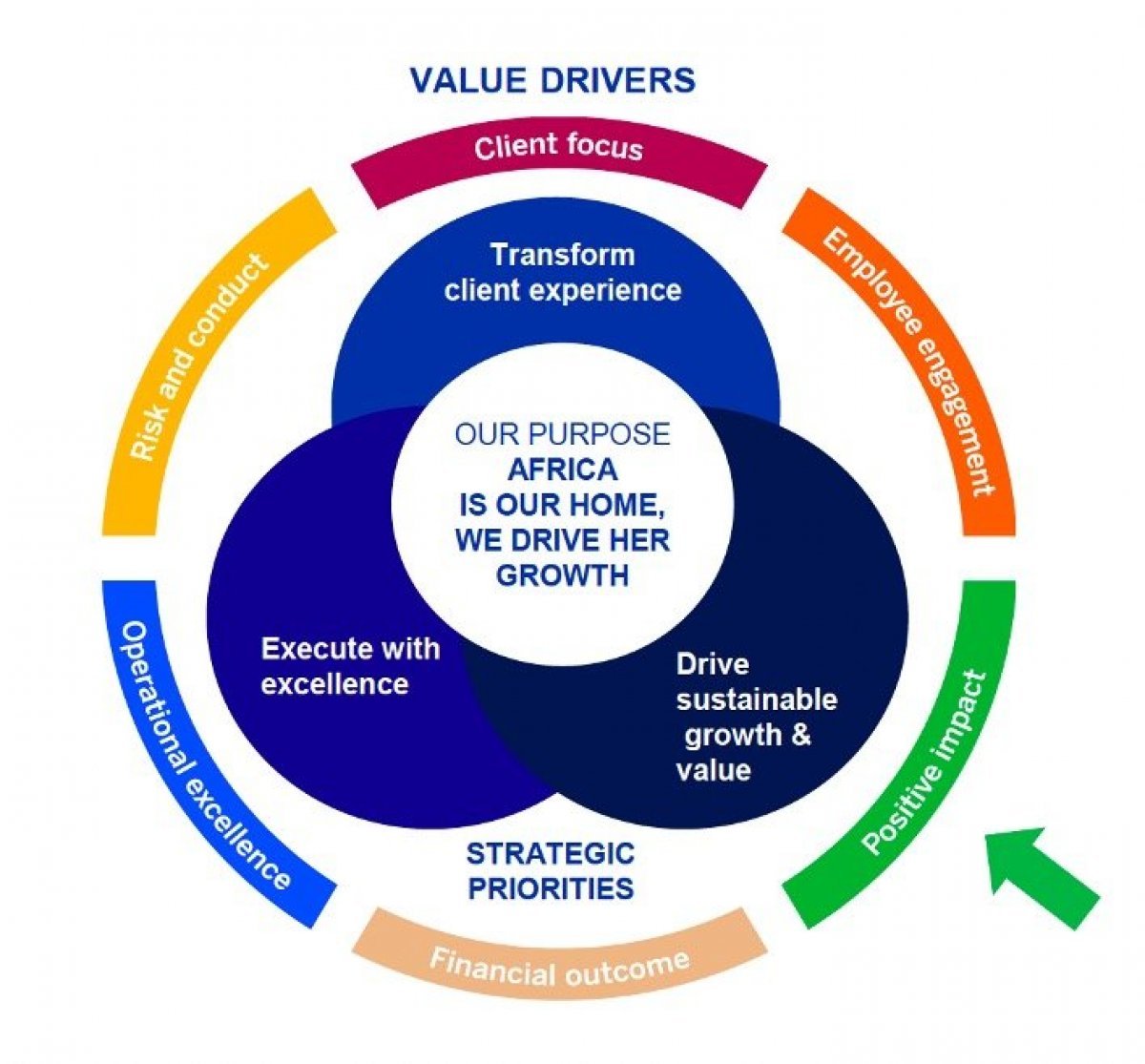
Selecting GIBS as learning partner for the programme was informed by the school’s focus on Africa, and alignment with Standard Bank’s purpose, which states that “Africa is our home, we drive her growth” (see Figure 1). The bank leverages its expertise, insights, and deep understanding of African markets to empower clients, enhance their financial well-being, and build a resilient and thriving African economy.
“The success of the programme is rooted in the strong partnership between Standard Bank and GIBS,” said the director of GIBS sustainability initiatives for Africa, Dr. Jill Bogie.
“Together, we designed a curriculum that not only addresses the current challenges but also anticipates future trends in sustainability and finance. What excites me most is seeing how participants are applying their learning to real-world challenges, creating tangible impact within the bank and beyond,” she added.
The business case for sustainability: Defining the risks
Businesses are increasingly aware of the importance of identifying, assessing, and managing ESG risks. This awareness has been driven by factors such as regulatory pressure in some jurisdictions to improve ESG-related disclosures, growing interest among shareholders in companies’ ESG performance, and growing awareness of the transition and physical risks associated with climate change.
According to the World Economic Forum’s (WEF) Global Risks Report 2024, ESG-related risks currently dominate the top global risks and will continue to do so for at least the next 10 years (see Figure 2).
In the short term, extreme weather events ranked as the second-most severe global risk in 2024. In a ten-year timeframe, the most severe risks include extreme weather events, critical change to earth systems, biodiversity loss and ecosystem collapse, and natural resource shortages.
How prepared is business to deal with these risks, and how will organisations adjust their business models and operations to ensure their sustainability in a rapidly changing world?
The first challenge is to ensure that ESG-related risks are properly understood and managed across the business, rather than treated as a catch-all but rather meaningless phrase. “The environmental, social, and governance agenda has not delivered and in its current form it never will. ESG as we know it is over. In the decade ahead, businesses must compete not just for market share but for the future itself,” Hooper wrote in the FT.
As a founding signatory to the United Nations Principles for Responsible Banking, Standard Bank aims to align its strategy with the UN Sustainable Development Goals (SDGs). This includes specific objectives in relation to climate risk mitigation and adaptation. The group supports the goals of the Paris Agreement and the UAE Consensus adopted at COP28 in December 2023. It has committed to achieving net zero carbon emissions for its lending and investing activities by 2050, and in relation to its own operations, by 2030 for newly built facilities and 2040 for existing facilities. The bank plays a critical role in providing the finance needed for individuals, businesses, and economies to achieve climate resilience and mitigate emissions, and works closely with clients to design appropriate solutions.
“We know we are grappling with issues of sustainability, and our clients are too,” Swart explained. “We understand our climate-related opportunities and risks through a double materiality lens, and our approach is thus underpinned by two interconnected pillars: our climate policy, which aims to minimise our negative environmental and social impact, and climate risk management, which aims to manage the impact of climate risk on the group.”
The bank sees sustainability as a strategic priority, presenting opportunities to maximise the positive impact it can make. This includes its ambition to become the leading enabler of the energy transition on the continent. “Sustainability is seen as a future skill for staff, a capability that Standard Bank is building among its people across the group,” said Swart.
Sustainability ambitions: The ESG & Sustainability Advanced Development Programme
The global finance and banking industry is under pressure to integrate sustainability into core operations and ensure that their portfolios and decision-making processes align with effective ESG risk management and global commitments.
For Standard Bank, “sustainability is embedded in our purpose and strategy. One of our three strategic priorities is to drive sustainable growth and value,” Swart said.
Standard Bank Group’s ambitions for sustainability include:
- maximising positive impact on societies, economies, and the environment
- effectively managing environmental, social, and governance risk
- to be the market leader in sustainable finance, including financing the just transition
- partnering with clients to support their transition journeys.
In line with these ambitions, Standard Bank aims to mobilise R250 billion in sustainable finance across all banking products by the end of 2026. This includes green solutions, such as financing renewable energy infrastructure, and social solutions, such as small business finance and loans for affordable housing.
“The economic value we generate for our shareholders must be underpinned by creating value for society. By supporting the well-being of our clients and potential clients, while managing the risks to the environment, now and in the future, we support the sustainability of our business,” Swart said.
In alignment with the bank’s ESG goals, the ESG & Sustainability Advanced Development Programme was designed to enhance the sustainability knowledge and capabilities of the bank’s leaders to ensure they can effectively integrate ESG principles into their strategic decision-making processes. Additionally, the bank identified the necessity of equipping client-facing leaders and their teams with the skills to identify and capitalise on ESG opportunities in every client engagement.
The programme design is structured to foster a culture of innovation by enabling leaders to construct and deliver innovative, client-focused financing solutions to drive sustainable growth and value creation. The initiative aims to ensure that the bank can guide clients through their own sustainability journeys, positioning Standard Bank as a thought leader in the ESG space.
Course design
The Standard Bank ESG and Sustainability Advanced Programme began in partnership with GIBS in 2023, reflecting a shared commitment to developing future-ready leaders. The Cambridge Institute of Sustainable Leadership, as global best practice leader in sustainability, is an advisory partner on the course.
Initially, the course targeted all members of the corporate and investment bank, aiming to develop an understanding of environmental, social and governance (ESG) measures and to develop an awareness of the bank’s sustainability goals and strategy. It has since been expanded to all senior employees, with attendees from across the bank’s operations in Africa and globally. Four cohorts have completed the course to date.
For those in client-facing roles, the programme aims to develop a thorough understanding of sustainable finance instruments, identifying ESG opportunities in every client engagement in order to drive sustainable growth and value.
The programme’s modules connect to Standard Bank’s purpose and strategy for sustainable growth, charting strategic client opportunities and constructing innovative client solutions.
The structure of the programme has allowed for the sharing of ideas and knowledge across functions within the Standard Bank Group, resulting in unexpected synergies.
The programme is designed around three core modules:
- Module 1: Connect sustainability and ESG to the bank’s purpose while creating a personal connection to these concepts among delegates.
- Module 2: Chart opportunities by identifying the ESG opportunities in every client transaction.
- Module 3: Support clients as a team to help them innovate and create solutions.
Project ideas are presented to a panel at the end of the programme as a final assessment.
GIBS Sustainability Initiatives Africa
GIBS Sustainability Initiatives Africa (SIA) is a communication platform that presents the work on sustainability that GIBS does with companies and multi-stakeholder organisations, including the United Nations.
As a signatory to the Business Schools for Climate Leadership Africa Initiative and as a United Nations Principles for Responsible Management Champion School, GIBS sees its role as more than just a stand-alone climate issue or one of only compliance.
GIBS sustainability initiatives include:
- Business Schools for Climate Leadership Africa
GIBS is a founding member of Business Schools for Climate Leadership (BS4CL) Africa, an initiative formed in November 2022 ahead of the COP27 meeting in Egypt. - Principles for Responsible Management Education (PRME)
GIBS is a signatory of the United Nations Global Compact initiative Principles of Responsible Management Education. GIBS is also a member of the PRME Champions group. To qualify as a PRME Champion, business schools must demonstrate a steadfast commitment to nurturing future leaders through responsible management education, aligning with the objectives outlined in the United Nations Agenda for Sustainable Development. - Working with UN Global Compact Network South Africa
GIBS has hosted the offices of the UN Global Compact Network South Africa (GCNSA) since 2018 and Dean Prof. Morris Mthombeni sits on the Board of GCNSA.


Gallery