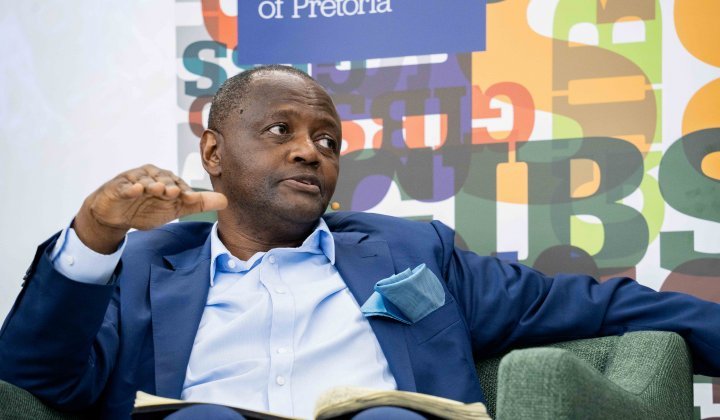
In a wide-ranging panel discussion at the Dean’s Annual Alumni Breakfast 2026, leaders from business, consulting, and the public sector examined South Africa’s economic and industrial outlook on the back of the State of the Nation Address (SONA) and Budget Speech 2026.
Setting the scene, GIBS Dean Prof. Morris Mthombeni reflected on the early part of his career at the School and Eskom, highlighting how changes in leadership had a positive impact on the economy and the stability of the power utility. At the time, he said, executives studying at GIBS were reluctant to be associated with the state utility – a regrettable stance, given they were building their careers. Fast-forward, the scale of reform and the work undertaken at Eskom mark a proud turnaround for both the organisation and the country.
Prof. Mthombeni was joined by Dr. Candice Hartley, group chief people officer at Eskom, Dr. Paulina Mamogobo, DBA alum and chief economist at The Automotive Business Council, Dr. Adolf Makgatho, MBA alum and South Africa managing partner at McKinsey & Company Africa, and Dr. Mark Lamberti, DBA alum and chairperson of Lamberti Holdings.
Responding to SONA, Dr. Lamberti said President Ramaphosa’s address struck a poetic tone but must be viewed in global context. The world faces unprecedented geopolitical, economic, and military turbulence, as noted by Canadian Prime Minister Mark Carney at the World Economic Forum. Africa’s 54 countries, 1.5 billion people and $2.8 trillion GDP present significant opportunity. South Africa, despite slow growth, inequality, and governance challenges, remains relatively well positioned, with inflation, bond rates, the currency, and the budget showing resilience. However, Lamberti argued, SONA did not clearly outline how the country will leverage its strengths to build new trade ties in a multipolar world.
From an industry and trade perspective, Dr. Mamogobo said South Africa continues to see global shifts. The country’s competitiveness has historically relied on global markets. For example, 70% of vehicles produced domestically are exported. Trade disruptions such as US Section 232 tariffs and EU non-tariff barriers pose risks to production and employment. She said the domestic market is insufficient to sustain production independently, highlighting the need for integrated African markets. Mamogobo advocated a hub-and-spoke model: South Africa as a manufacturing hub, leveraging neighbouring countries for specialised production, creating an African-made supply chain to reduce costs and reliance on imports.
From a business advisory perspective, Dr. Makgatho said SONA signalled an effort to reposition South Africa within a fractured global order, while stabilising market fundamentals, credit outlook, and rising costs. The message of fiscal consolidation without austerity was clear, alongside a focus on infrastructure-led growth and alignment between government and National Treasury.
Energy reforms, including lifting licensing thresholds, have unlocked significant private generation, while logistics concessions and a narrower fiscal deficit – from about 9% of GDP during Covid to about 4% – show intent and consistency.
However, he said the gap lies in execution and regulatory certainty, which are critical to crowding in long-term private capital.