
Where culture, engagement, and internal communications intersect
External marketing tends to attract the glamour. Companies invest heavily in campaigns, media, and brand reputation. The daily internal experience of employees often receives a fraction of the attention. This shows up in inconsistent service and performance, and a brand that says one thing externally while living something different inside.
As Colin J. Browne, founder of Happy Sandpit, puts it, culture is simply “the way we do things when nobody is watching”.
Culture drives engagement. Browne describes engaged employees as “people who do more than they have to because they want to”.
Research definitively shows that engagement drives performance (Gallup data shows engaged employees achieve 23% higher profitability and 18% higher productivity). Given this, internal communication becomes far more than information-sharing. It’s about helping people make sense of the organisation, see their role in the bigger picture, and how they understand how they join the mission. But whether internal communication is terrible, average, or outright brilliant, it won’t matter unless it flows from a healthy culture.
Culture before communication
Browne argues that organisations often misunderstand culture because they treat it as something to “achieve”. In practice, culture is not an end state. It is a mechanism for creating engagement.
“Businesses come to us asking for culture change,” he says, “but what they really want is a performance improvement – better sales, better customer service, better product development. You achieve all of that more easily with engaged people.”
If engagement is the outcome, culture is the lever. Communication is the expression of that culture. When the underlying culture is unclear or contradictory, internal communication becomes messy, inconsistent, or is simply ignored. If internal communication is weak, the external brand promise becomes difficult to deliver because employees operate without a clearly understanding why their work matters.
This is where Browne sees a long-standing gap:
- HR is often responsible for internal communication, but HR tends to communicate in a policy tone (accurate, but rarely compelling).
- Marketing knows how to inspire, energise, and move people to action, but may not have the proximity to operational realities.
- The strongest internal communication emerges when these functions collaborate, guided by leadership that understands what the organisation stands for and the non-negotiables that make it distinctive.
“Culture isn’t about artefacts or posters,” Browne says. “It’s about intentionality. You must be able to describe who you are in a way that compels people to feel involved.”
Inside-out in practice
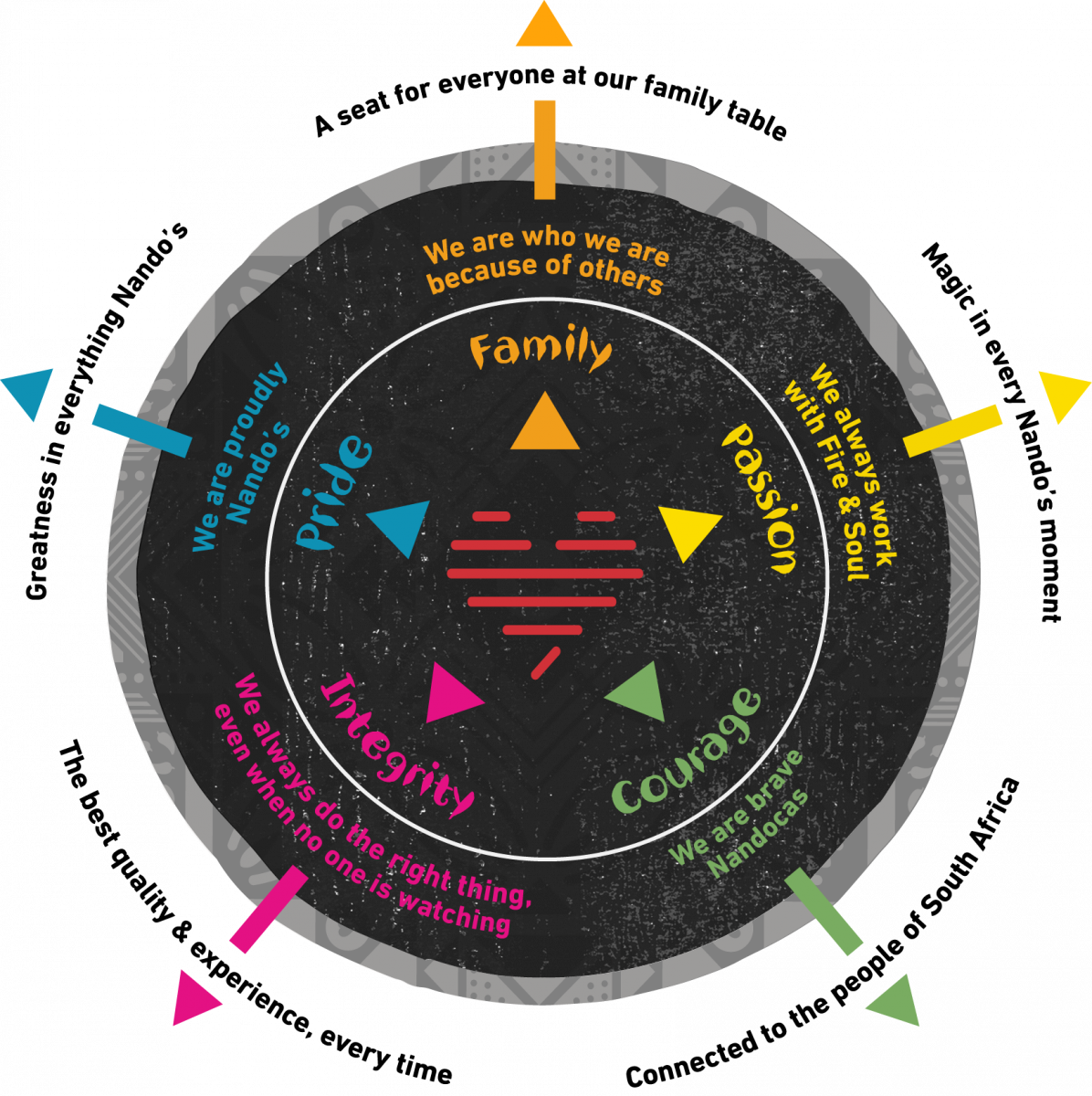
Kirsty Niehaus, the general manager for hospitality at Nando’s, attributes the concept of the inside-out brand to founder Robbie Brozin, who always says, “It’s the people who make the chicken.”
“At Nando’s we believe it’s the passion and spirit in every Nandoca (our employees) that’s makes our flame-grilled peri-peri chicken taste so delicious,” says Niehaus. “The internal culture, driven by our compass and values, is at the heart of everything we do, how we communicate, and our daily behaviours. It’s who we are! In practice that means the internal experience drives our restaurant and brand experience. A positive, values-driven workplace creates consistent, authentic guest experiences. Nandocas are our best brand ambassadors – how we act, serve, and connect with guests reflects our brand identity. Marketing, messaging, and restaurant design simply reflect what’s already true inside the business – a fired-up, fun, and passionate energy driven by our purpose of changing lives.”
This orientation shapes every aspect of how Nando’s communicates internally. Messages are designed to be clear and conversational, and often a bit cheeky. The tone mirrors how Nandocas naturally speak to one another. The PERi-Post (the Nando’s award-winning monthly internal magazine) is created for Nandocas, by Nandocas – filled with stories written by employees themselves, celebrating growth, achievements, and everyday life in the restaurants.
Visual language is deliberate and inclusive. Short, TikTok-style videos keep content light and engaging. Heatwave Radio, the internal Nando’s station, gives Nandocas a literal voice across the business. With 80 percent of employees not having access to email, WhatsApp is a crucial channel for reach and accessibility.
Niehaus says internal communication plays a direct role in brand consistency. “If Nandocas feel the love internally, guests feel it. When Nandocas are inspired, know what we’re working towards, and understand their part in it, we have a collective force that’s unstoppable.”
Nando’s doesn’t treat internal communication as a broadcast function. It surveys employees twice a year, runs dipstick checks after campaigns and holds focus groups to test communication approaches. Recent work on Moments of Pride (the daily in-restaurant team meeting) involved a six-month phased roll-out with toolkits, coaching sessions, training workshops, and a radio competition. “It’s been a lot of work,” Niehaus notes, “but if Nandocas have a fired-up team meeting, the whole shift will be fired up. It’s been worth it.”
The lesson from Nando’s is that inside-out brands aren’t born from bursts of marketing genius but from cultures where the internal tone and experience are strong, coherent, authentic, and consistent.
The challenge of scaling culture
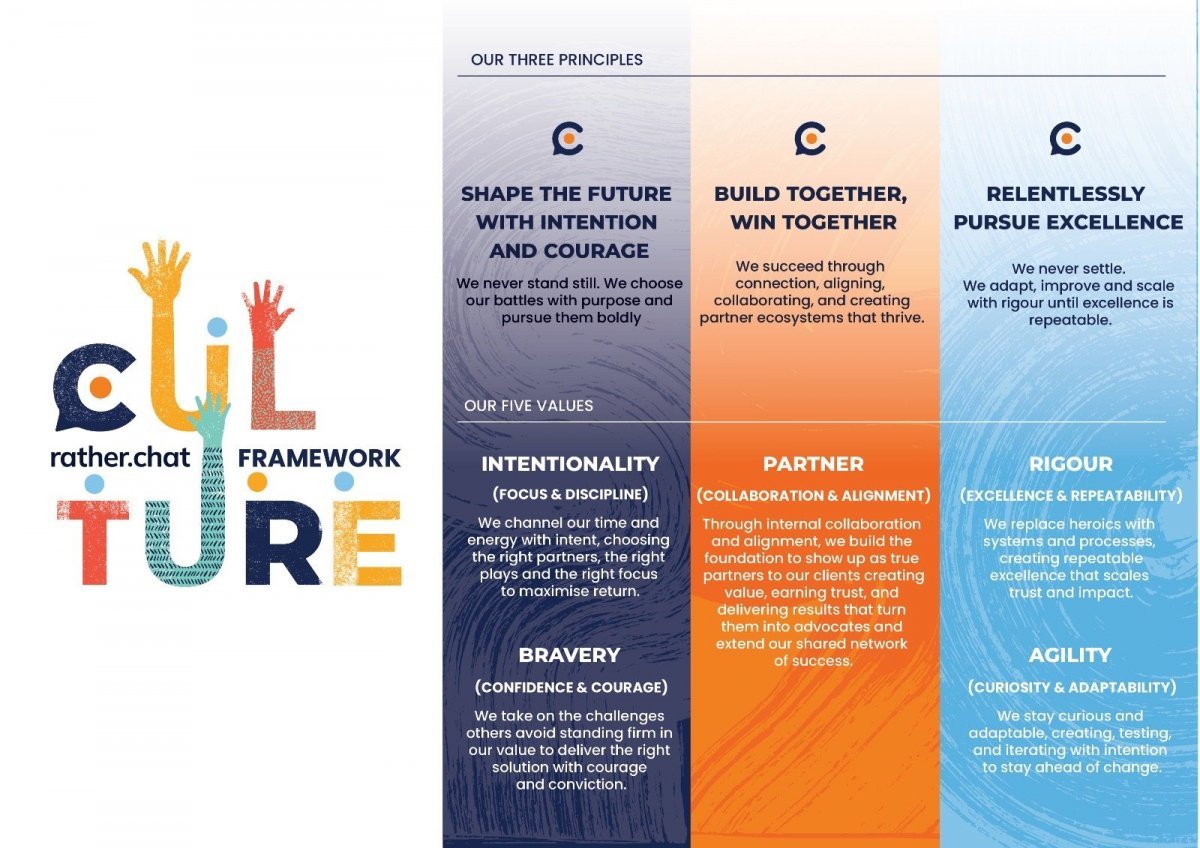
If Nando’s represents a mature inside-out brand, rather.chat (a SaaS startup that offers chat automation solutions to power sales in WhatsApp) sits at the opposite end: an evolving company, confronting the reality that scaling up requires an identity and culture shift – not just a growth phase.
Founder and CEO Jonathon Elcock describes the early years as “heroics” – everyone doing everything, improvising constantly, fuelled by passion and urgency. That worked brilliantly at five people, he notes. At 30, it created chaos.
According to Mandy Waddington, head of marketing and strategy, the challenge was authenticity – the company needed a culture narrative that reflected reality, not a set of corporate clichés.
Recalling early encounters with agencies that produced polished CI work without depth, she says, “They delivered a logo with no substance.” What they needed was clarity about their value proposition and the behaviours that made them effective.
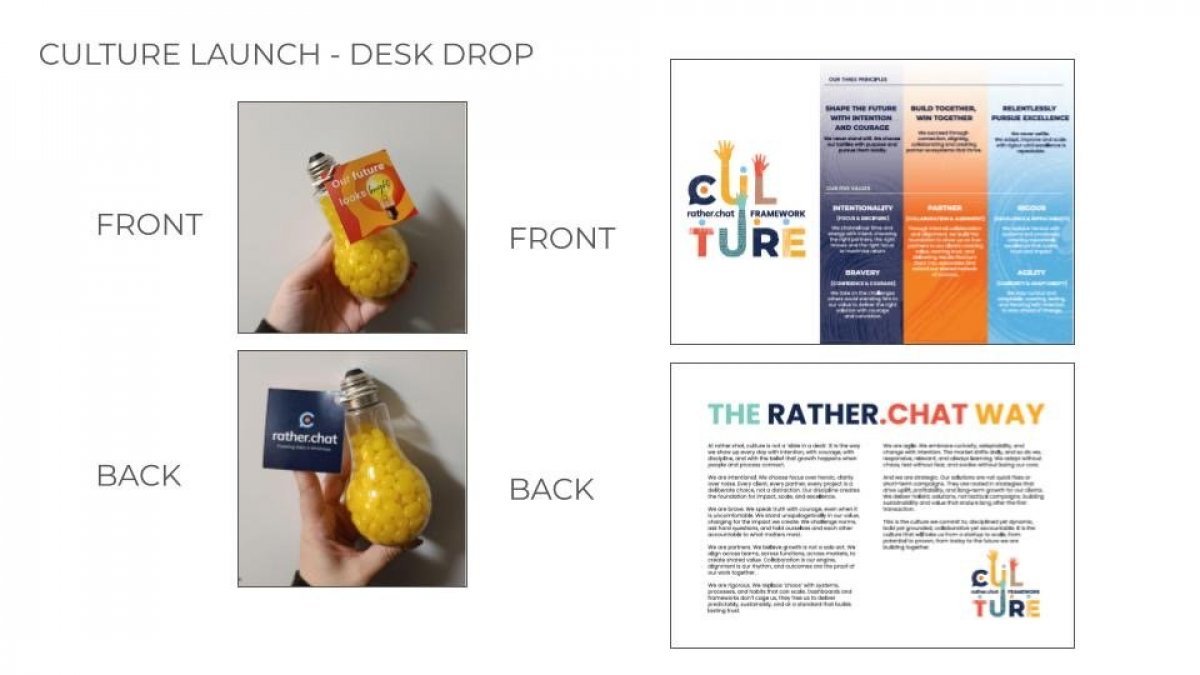
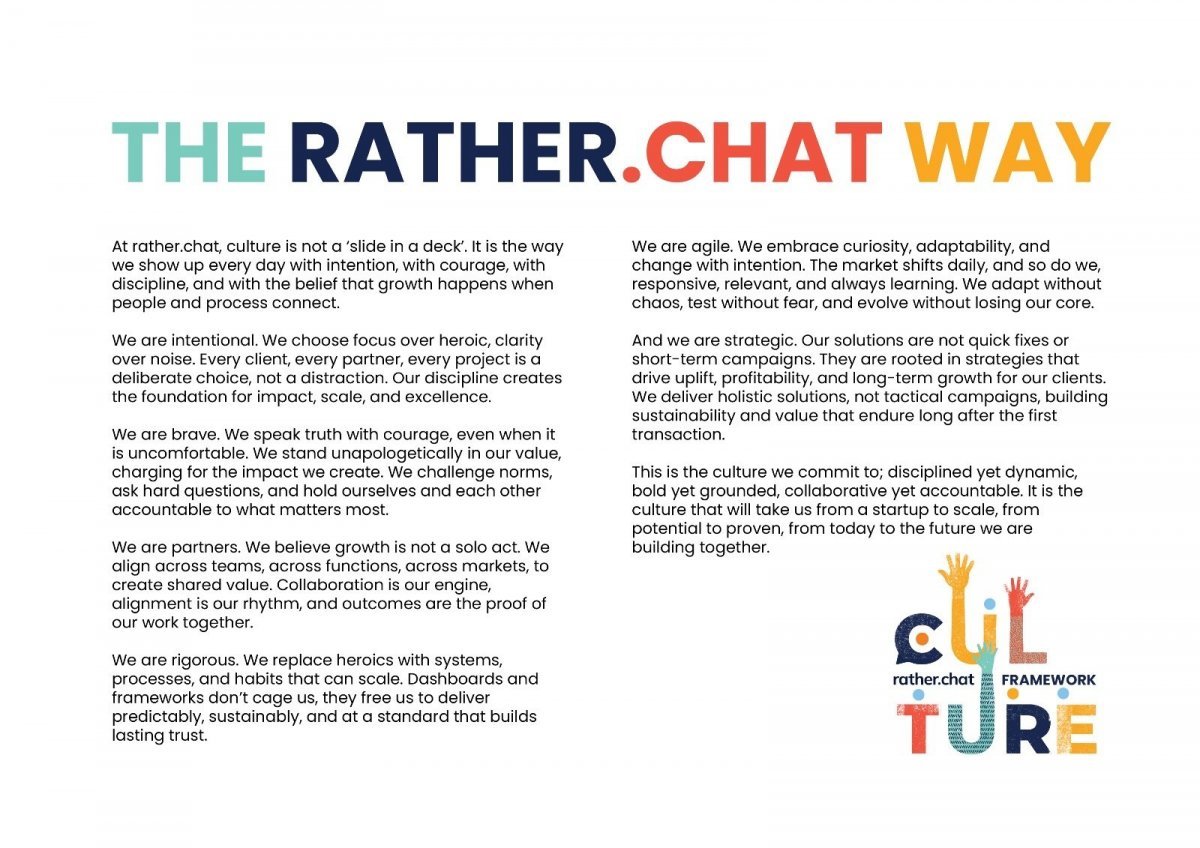
The turning point came when leadership acknowledged that without formalising culture, onboarding new people would dilute what made the business successful. They defined principles, values, and behaviours; drew the organogram and formalised roles; linked KPIs to expected behaviours, and identified what was non-negotiable.
While that all sounds very process-driven and slick, Elcock and Waddington say it meant having tough conversations. Many people see Elcock as a father figure – tough conversations feel like “losing the father’s favour”. But the team put truth-telling at the heart of their culture.
Elcock recalls an example of not leaving someone sitting in a role where there was no real work or future, and how huge the relief was (for everyone involved) when they finally had the honest conversation.
He speaks openly about wanting to avoid the “emperor’s new clothes” dynamic, where leaders are failing and no one says so. Even when it means uncomfortable conversations, it’s important to avoid sanitised internal communications.
Transparency is paramount, although Elcock stresses it’s not a “kumbaya culture”. It’s consultative, yes, but ultimately the founder and management team still set the direction and values. People are invited into the process, not asked to invent the whole thing.
The lesson here is that internal communication should be a tool of alignment rather than firefighting – rather.chat could not tell a coherent internal or external story until it had defined who it was. As Waddington puts it, authenticity isn’t about aspiration; it’s about accurately describing the organisation at its best, and then ensuring the systems and communication reinforce that.
Clarity is core
For leaders wanting to strengthen internal communication, the first step is not a channel – it’s clarity. Browne suggests organisations start by understanding what makes them distinctive, “the thing you live or die by”. Nando’s formalises this through values, tone, and rituals. rather.chat is codifying its own.
Browne’s and Niehaus’s practical starting points include:
- Ask employees what works and what doesn’t.
- Study how they naturally communicate in their personal lives.
- Map major internal messages to strategic priorities.
- Define a simple culture narrative: who we are, how we speak to each other, how we behave.
- Align HR and marketing so internal communication is correct and compelling.
- Give employees a voice – co-create, invite stories, listen actively.
- Measure and refine continuously.
Internal communication is powerful because it aligns people around a shared purpose and shared way of working. When people understand the “why”, they participate differently and lead differently.
Four elements of effective internal communication
- Know your audience: Communication must match the daily reality and identity of the people receiving it. Browne shares examples of mining supervisors delivering training to workers in isiZulu, and a tech firm that frames its values in the language of Star Wars, Star Trek and Lord of the Rings. Meaning lands when it feels authentic and relevant. Similarly, Nando’s uses humour, images and voice notes because that’s how Nandocas communicate with one another.
- Align internal and external comms: Browne tells of a joke where a good man dies and is met by St. Peter at the gates of heaven. He’s offered his choice of heaven or hell. Heaven looks great (beatific cherubs and peaceful harp music abound), but he opts to visit hell to assess his other option. Peeking through the keyhole, which is all the devil will allow, he sees a great party and decides to seal his fate and elect to stay in hell. The gates open, he enters and suddenly the party has gone – replaced by torture and much wailing and gnashing of teeth. “What happened to everything I saw through the keyhole?” he asks. “Ah,” says the devil, “That was when we were recruiting you. Now you’re an employee.” An extreme example, but one that highlights the danger of treating internal and external messaging as separate. When the internal story and external promise diverge, employees feel misled and customers feel inconsistency.
- Leadership shapes the narrative: Communication sits across HR, marketing, operations, and learning. But leadership sets the values and behaviours that communication must express. Without clarity at the top, internal comms becomes a patchwork of competing voices.
- Listening is not considered optional: Hierarchies are often “designed to prevent information from floating upwards”, Browne notes. Internal communication becomes meaningful when employees see that their input leads to change. Nando’s surveys, dipsticks, focus groups, and iterative testing embody exactly that principle.


Gallery