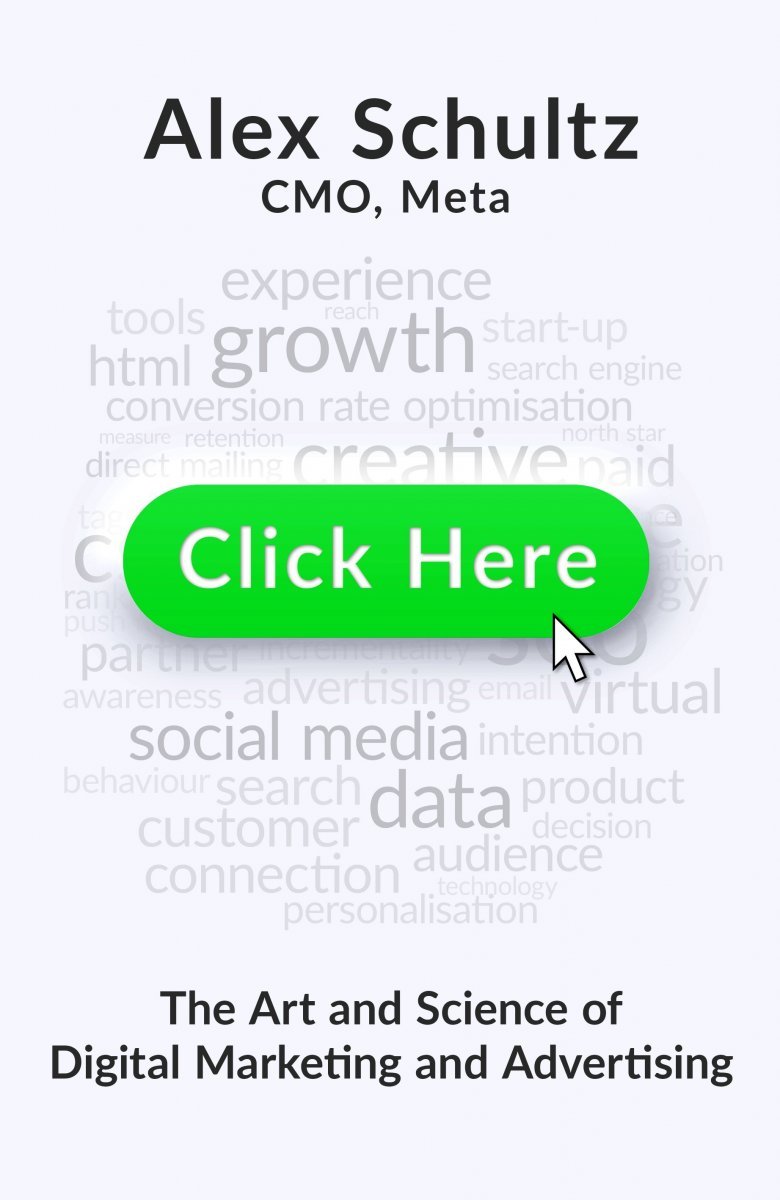
Click Here: The Art and Science of Digital Marketing and Advertising
Alex Schultz
Headline – R470
This is a tough one to review. Cambridge-educated Alex Schultz is the chief marketing officer for Meta, parent of Facebook, WhatsApp, and Instagram. Digital marketing and advertising are at the very heart of these hugely successful businesses; self-evidently Schultz is extremely good at what he does. In his introduction to Click Here, he explains that he looked around for a basic handbook on how to do digital marketing and advertising, couldn’t find one, and so he set out to fill the gap.
He has certainly produced a thorough and comprehensive handbook, but I’m not certain that I would describe it as basic.
Schultz says his book has two guiding principles: “Tools evolve, but principles are timeless” and “Incremental results are everything”. He refers repeatedly to one of the fathers of modern advertising, the late David Ogilvy, and his masterpiece, Ogilvy on Advertising. A signed copy of that work is one of my most treasured possessions, so I’m very much in alignment there.
The book is structured into three parts: The Basics, The Infrastructure, and The Channels. Again, so far, so good. But as we make the transition from the first to the second, it becomes apparent that Schultz operates on a level well above ordinary mortals. There’s a clue to the root of the problem early on, when he reveals that he paid his way through university by developing and running a website dedicated to paper aeroplanes and writing a book on the same topic. He explains this as if it was the easiest, most natural thing to do and it made him significant amounts of money. He later confesses that at Meta, he is known as the “numbers nerd”, because he wants to measure and quantify everything.
It’s that “nerdiness” that takes Click Here out of the realm of basic and elevates it to the realm of textbook. I did my MBA in the mid-90s, and its thesis was on database management, so I should have found this easy going. Instead, I have to confess that by the middle of his book, Schultz had lost me in the technicalities.
One other worry is that he refers to small companies and businesses and rightly says that the principles he recommends apply as much to them as they do to the mega-corporations. However, many of the strategies and solutions he puts forward to achieve the flawless execution he requires would need large teams and equally large budgets. Not all of us have the resources of Meta at our disposal.
This is not a casual read; far from it. It requires a level of attention that I might have applied had I been studying for a degree now, or if I were a full-time digital marketing professional. Under those circumstances, it’s a highly valuable, well written, and well-thought-out work.
But what Schultz doesn’t explain is why I am constantly bombarded, day after day, month after month, by an ad for a deodorant that I have never bought nor searched for online (Nivea), for a fibre provider when I don’t need one (Rain), and why I keep receiving ads in foreign languages I don’t speak.
Clearly, a number of other marketing and advertising directors should also read Click Here!
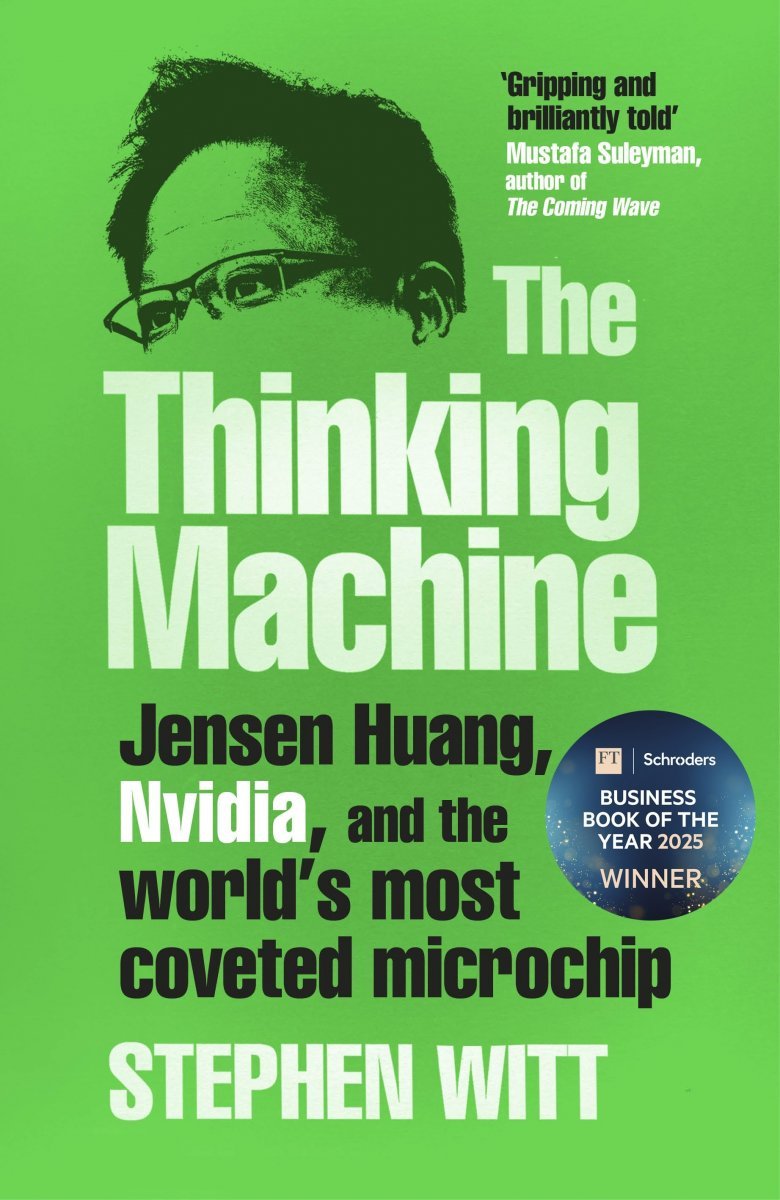
The Thinking Machine: Jensen Huang, Nvidia and the World’s Most Coveted Microchip
Stephen Witt
Bodley Head – R440
It’s not hard to understand why this book won the 2025 Financial Times Book of the Year award. It’s a very straightforward account of the origins of Nvidia’s CEO, Jensen Huang, and the company he built from scratch to become the world’s most valuable (at the time of writing).
But if that sounds prosaic, don’t be fooled. It’s a quite remarkable story covering not only the rise of a talented and supremely hard-working individual, but also the rise of the technology that now underpins at least 80% of the world’s AI initiatives. Witt’s writing covers the ground rapidly with an easy-reading style that belies the rigour and depth of his research. No paid-for biography this, but he has had access on a fairly regular basis to Huang. He has also interviewed just about every other major player in the AI world, including Nobel Prize winner Geoffrey Hinton, who also won the Turing Prize with collaborators Yoshua Bengio and Yann LeCun. They’re there, too, along with key figures at Nvidia such as co-founders Curtis Priem and Chris Malachowsky.
Witt achieves three things. He charts the rise of Nvidia and how it morphed from a relatively obscure maker of chips for computer graphics into one of the dominant players in that somewhat unglamourous sector, and then to becoming the global engine room of AI.
In parallel, he also reveals an intimate portrait of Huang himself and how he changes from driven, smart CEO into a global tech superstar. Along the way, we see into Huang’s lifestyle and get glimpses of his family. It’s always difficult – pretentious, even – to say, after reading a book like this, “I know the man, I know Jensen Huang”, but Witt takes the reader much closer to his subject than many writers do.
He also recounts the development of the technology, including the emergence of parallel computing and transformers. These were the steps that so radically altered AI’s possibilities. Until then, AI had been considered a pipe dream at best, a waste of academic resources at worst. Almost overnight, the rules changed and Nvidia’s chips were in huge demand all over the world, its share price going stratospheric. Witt’s achievement is to lift the lid in such a way that ordinary readers can understand the nuts and bolts.
One theme that runs through The Thinking Machine is the potential for AI to take over the world, destroying humanity along the way. It’s something Hinton himself has worried about in public, along with several dozen others. Jensen Huang is dismissive, angrily so at times. Where I do think Witt misses a trick is to pose the possibility as an either/or: either AI will destroy humanity or it won’t.
But what might happen if this tool, which everyone agrees is incredibly powerful, were to fall into the wrong hands? Into the hands of someone not intent on destroying humanity, but rather enslaving or controlling it? We can already see what happens to facts and history in Vladimir Putin’s Russia and Donald Trump’s America. A world in which we are told what, where, and when to think has already been described by George Orwell in 1984. Could Nvidia’s extraordinary AI chips become the foundational blocks for Orwell’s thoughtcrime?
It’s a terrifying possibility and one of the reasons you need to read Stephen Witt’s The Thinking Machine.


Gallery