
Artificial intelligence (AI) is dominating the global conversation. Yes, it’s fuelling fears around negative cognitive impacts, data and personal privacy concerns, the changing way we consume information and news, unauthorised content use, copyright conundrums, and impacts on human creativity, but the AI march seems unstoppable.
There is one wildcard though: how humans ultimately choose to use these tools.
Earlier this year, learning technology entrepreneur Marc Zao-Sanders shared insights into how people are using generative AI in their day-to-day and professional lives. The results – particularly when compared to his 2024 findings – were eye-opening.
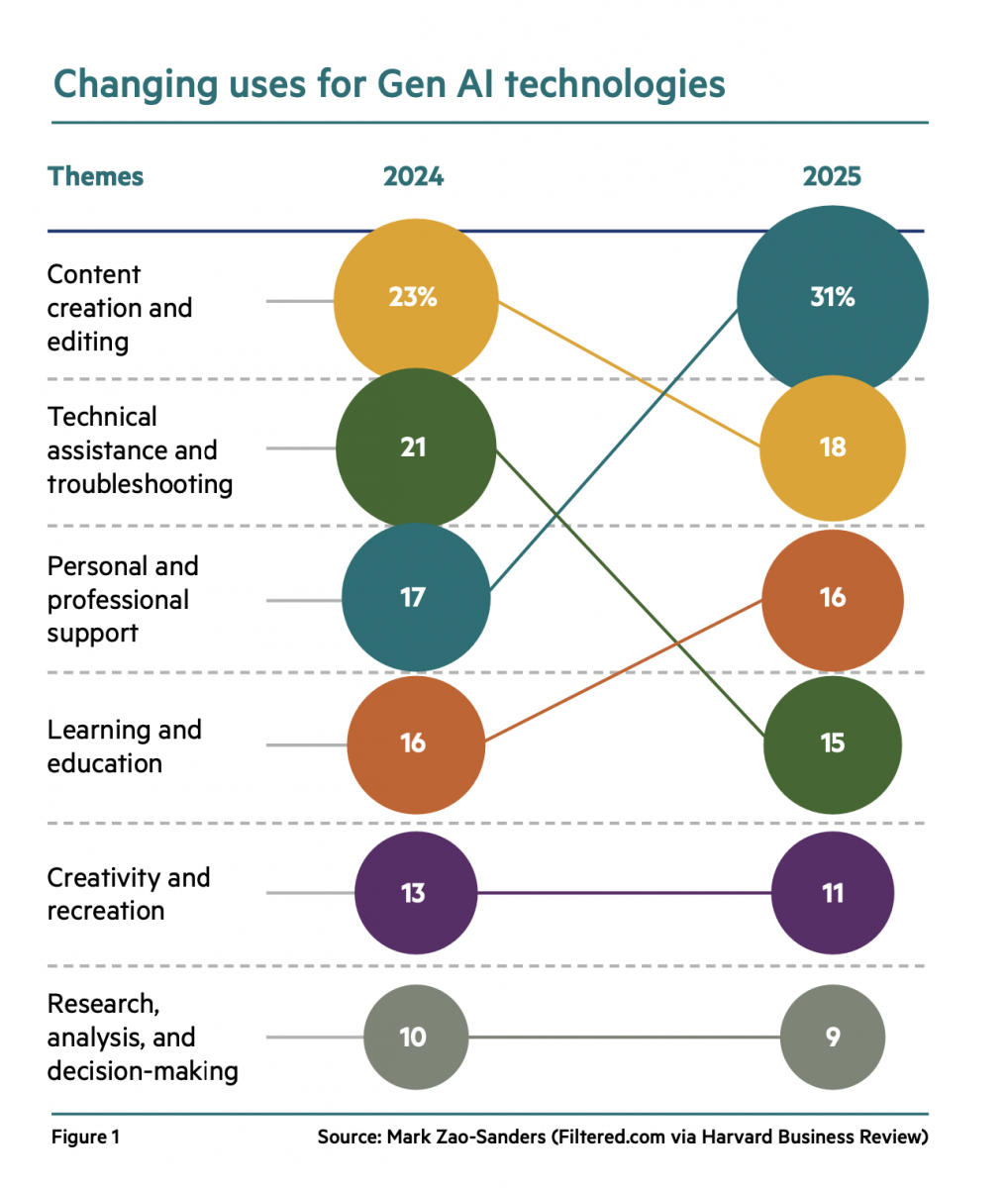
One year on from the first report, and not only are there more AI tools available but they are increasingly cost-effective. The biggest shift in usage (Figure 1) is towards personal and professional support tools (17% in 2024 to 31% in 2025). Content creation and research analysis plus decision-making support actually dropped, from 23% to 18% and 10% to 9%, respectively.
Figure 1: Changing uses for Gen AI technologies
[insert figure]
Source: Mark Zao-Sanders (Filtered.com via Harvard Business Review)
Based on an analysis of comments shared primarily on Reddit forums, Zao-Sanders’ team identified 100 uses ranging from personal training plans (100th spot) to explaining technical documents (81st), brain dump (68th), and making sense of academic papers (60th). These uses were then lumped into themes.
Grouped under the personal and professional support theme was the top application: using Gen AI for therapeutic needs or companionship capabilities. In the report, a South African respondent was quoted as saying, “Where I’m from, in South Africa, mental healthcare barely exists… Large language models are accessible to everyone, and they can help. Unfortunately, data safety is not a concern when your health is deteriorating, and survival is the morning agenda.”
It is estimated that the number of psychologists per 100 000 South Africans is between 2.5 and 2.75, and psychiatrists at around 1.53 per 100 000. In the absence of sufficient human professionals, the findings show South Africans are turning to AI. Even GIBS offers an AI-powered wellness app that offers support and resources to help students avoid burnout.
The growing uptake of this AI use category is not, however, just about therapy and coaching. It extends to life organisation, enhanced learning (such as note taking or information sourcing), health, and well-being planning.
AI for learning
Of all these sub-categories, enhanced learning is of particular relevance to institutions like GIBS.
Does this point, for instance, to an increased preference for gamification of education in the form of, as one participant in Zao-Sanders’ study put it, “getting to watch and/or participate in a conversation between historical people who didn’t exist at the same time, like Einstein and Newton, for instance”. Or does it throw up concerns around teaching styles and methods, as per this quote, “Most students fear asking questions because they feel it might be dumb. Now you can ask ChatGPT any dumb question.”
While AI tools have implications for how education is delivered and students are engaged, for many in the world of higher education and academia the potential to maximise research output is the biggest drawcard.
A writing and research aid
With academic writing and research output being such a cardinal part of higher education, a lot has been written in recent months about the impact of AI use in this world. As Australian academics Mohamed Khalifa and Mona Albadawy wrote in a 2024 article, “AI transforms idea development and research design by providing valuable insights and optimising methodologies. It enhances content quality through writing assistance and emotional tone analysis. In literature review and data management, AI’s ability to process large data sets ensures comprehensive analysis and integrity. AI also streamlines the publishing process and supports ethical compliance in research dissemination.”
What should not be overshadowed, the authors warned, is the “creativity and critical thinking inherent in human intelligence”.
During a recent interview with Prof Charlene Lew, GIBS’s director for internationalisation, about the trajectory higher education is taking, she too highlighted the growing significance of understanding human behaviour alongside the potential to leverage emerging technologies. She disclosed that for her “the opportunities and challenges of AI have opened up new doors”.
Sharing insights into her use of AI tools, Lew said she uses AI daily as “assisted intelligence”. She explained, “It accelerates my ability to craft ideas. I also use it to challenge my own critical thinking. AI promises a completely new world in which we will live and work in future, and I’m excited to be on this unfolding path.”
A technology-friendly approach
Back in 2023, mere months after ChatGPT was launched to the public in late 2022, GIBS had already taken a position on the use of AI tools as a learning support and writing assistant. At the time GIBS professor and incumbent Deputy Dean Louise Whittaker told the Financial Mail, “MBAs are supposed to teach leadership and personal mastery skills as well as technical skills. AI cannot replace or even teach those.” However, GIBS faculty were not ripping these tech tools out of curious students’ hands, but instead were “actively asking students to get AI to generate text that they then have to critique to produce more refined, applied answers”, noted the magazine.
This approach is fast emerging as the pragmatic gold standard for the use of AI in education. A tool which, as US-based professor Jeanne Beatrix Law says, can be a writing partner, an “asset for creativity”, and a way to interrogate new ideas.
Helping students to develop healthy AI use habits will increasingly require professors themselves to start role-modelling transparent and ethical use. Already, GIBS faculty members are experimenting with AI tools; some extensively and others less so. Platforms such as Gemini, ChatGPT and DeepSeek are being used for language checking, idea and research framing, and even video creation – but, so far, not for wellness support.
PROF MANOJ CHIBA
GIBS MBA director
Do you use AI?
Yes, and I build my own agentic AI.
Which platforms do you use?
I use a host of platforms, depending on what I may need. ChatGPT, Claude, Gemini, Grok and Perplexity are the main ones, and obviously Meta AI as well. I don’t over-rely on them. There is a study on something that I long suspected, that over-use is creating “cognitive debt”.
What do you use AI for?
For everyday questions (what we would have Googled), for editing, coding, sometimes to reason, deep research with reasoning, web search, voice chat, image generation, and video generation. These are the main ones, but there are also many ad hoc uses as well. All the above obviously within limits and within boundaries, and context dependent.
DR. JILL BOGIE
Director of GIBS Sustainability Initiatives for Africa
Do you use AI?
Yes – but very limited.
Which platforms do you use?
So far, ChatGPT.
What do you use AI for?
I am using AI in a small way – to create LinkedIn posts. I am doing it with a GIBS data analyst who is helping me to build content for two external LinkedIn sites that I manage, both related to GIBS activities with the United Nations’ Principles for Responsible Management Education initiative. The main site we are trialling is Business Schools 4 Climate Leadership Africa. I am not using AI anywhere else.
Essentially I identify an interesting article, put it through ChatGPT with an instruction to “focus xyz” and use the output to comment on the article in a post to try and generate some interest and discussion. Results so far are limited, but we are tracking stats of likes, impressions, and comments. We’re still in learning mode.
PROF. HELENA BARNARD
Director of the GIBS Doctoral Programme
Do you use AI? If so, which platform and what for?
I use ChatGPT, but not nearly as much as my children, who use it for everything from coding to coming up with the grocery list for a given recipe! I use it mainly for brainstorming, e.g. the theories that could be used to explain a phenomenon.
DR. JEFFERSON YU-JEN CHEN
GIBS senior lecturer
Do you use AI?
Yes. Extensively.
Which platforms do you use?
- Large language models: ChatGPT, Claude, Perplexity, Pi, DeepSeek, Gemini, Easy-peasy AI
- Pictures: ChatGPT, Easy-peasy AI
- Video and voice: Artlist, Sora, 11Labs
- Music: Suno
What do you use AI for?
- Mostly, finding new knowledge and self-education.
- As a support to educate my son.
- Recreation and messing around.
- Using Pi to help me to reflect and think.
Student and alumni insights
Informal discussions with business school students from several South African business schools shows that many are using a variety of AI tools to help synthesise and analyse large quantifies of data.
There was a decided buzz across various WhatsApp groups in February 2025 when the OpenAI’s deep research tool was launched. Many students were already using Google Gemini’s Deep Research.
Perplexity Deep Research, which was also launched this February, was another winner, which leveraged autonomous reasoning to generate in-depth reports on a variety of speciality subjects. Google’s freshly launched AI co-scientist – a system built on Gemini 2.0 and designed to help scientists to create hypothesis and formulate research plans – was touted as “something to keep a close eye on”, according to one student.
Similar excitement was generated in these groups to share when “Gemini 2.5 has dropped!”, that “Anthropic Claude 3.7 is out”, and to discuss the latest developments with DeepSeek R1, OpenAI’s ChatGPT 4.5, and the announcement of the specialised AI tool APA7 GPT, for formatting academic and research documents according to APA 7th edition guidelines.
Many of these AI tools are firm favourites among GIBS alumni and current students, including two former MBA students: Zinzile Luthuli and Nicol Mullins.
Zinzile Luthuli, GIBS Alumni Business Clubs vice-chair for new business ideas, uses AI platforms such as Click Up, Gemini, Meta AI, ChatGPT, and custom GPTs (generative pre-trained transformers) in her work. She explains, “It serves as a business assistant, coordinator, and research assistant. I harness AI for various purposes. It boosts my productivity, serves as a creative muse for writing, and helps me overcome procrastination, ensuring timely delivery.”
Part-time lecturer and managing partner at the Africa People Advisory Group Nicol Mullins deploys ChatGPT, Gemini, Perplexity and Beautiful AI on “almost all projects, to provide a springboard for work”. He also uses AI for refining reports, drafting communication material and creating marketing campaigns.
Points to ponder
- Do you know your Anthropic Claude 3.7 from your Gemini 2.5?
- Do you care?
- How – if at all – are you using artificial intelligence?
- What can you learn from others and how they are adopting AI tools?


Gallery