
The exponential advancements in AI have sparked widespread excitement and a rush toward AI implementations. Organisations are strategically prioritising the integration of AI-driven solutions. They are anticipating efficiency gains, enhanced customer experiences, and hoping to gain significant competitive advantages.
However, this enthusiasm often leads to what can be termed as “aimless execution”. A situation where businesses invest in sophisticated AI technologies without a foundational understanding of their data capabilities, governance structures, and workforce readiness. The allure of AI can overshadow the necessity of pre-readiness, resulting in poor implementation, inefficiencies, and even ethical risks.
To successfully adopt AI and align it with their aspired business objectives, organisations must first assess whether they are asking the right questions about their AI strategy.
Defining your intent
Before diving into solution mode, organisations must clearly define their strategic intent. This means identifying the why and what behind their AI ambitions rather than prematurely focusing on the how. Without a clear sense of purpose, AI investments risk becoming directionless, leading to wasted resources and missed opportunities.
Organisations should begin by asking:
- Why do we need AI? What business problems or opportunities are we trying to address?
- What are our desired outcomes? How will AI contribute to our strategic objectives, such as customer experience and operational efficiency, or amplify our growth strategy?
- What value will AI bring to our stakeholders? How will it impact employees, customers, partners, and our industry?
- What is our definition of success? What will be our tangible key measures of success, and how will we drive a continuous improvement mantra to our efforts?
By clarifying intent upfront, businesses can align AI initiatives with broader corporate goals, ensuring that every step taken in AI implementation has a purpose. This approach aligns execution to desired outcomes and enhances the likelihood of meaningful returns on investment.
Establishing a data-driven culture
A data-driven culture is the bedrock of any successful AI strategy. Without a commitment to data literacy across all levels of the organisation, AI implementations are bound to fail. If the workforce does not understand how to interpret, trust, or act on data insights, then AI becomes just another buzzword rather than a transformative tool.
Ron Young, chief executive officer and chief knowledge officer of Knowledge Associates International said it best: “These things can be achieved through ‘knowledge management’, the discipline of enabling individuals, teams and entire organisations to collectively and systematically create, share and apply knowledge, to better achieve their objectives.”
Organisations must foster a culture where data-driven decision-making is the norm across the entire organisation. This includes:
- Ensuring data literacy training for employees at all levels.
- Encouraging leadership to make strategic decisions based on data and its derived reporting rather than intuition.
- Promoting transparency in data visibility and supporting a culture of continuous improvement to ongoing data accuracy.
Maturity in data posture
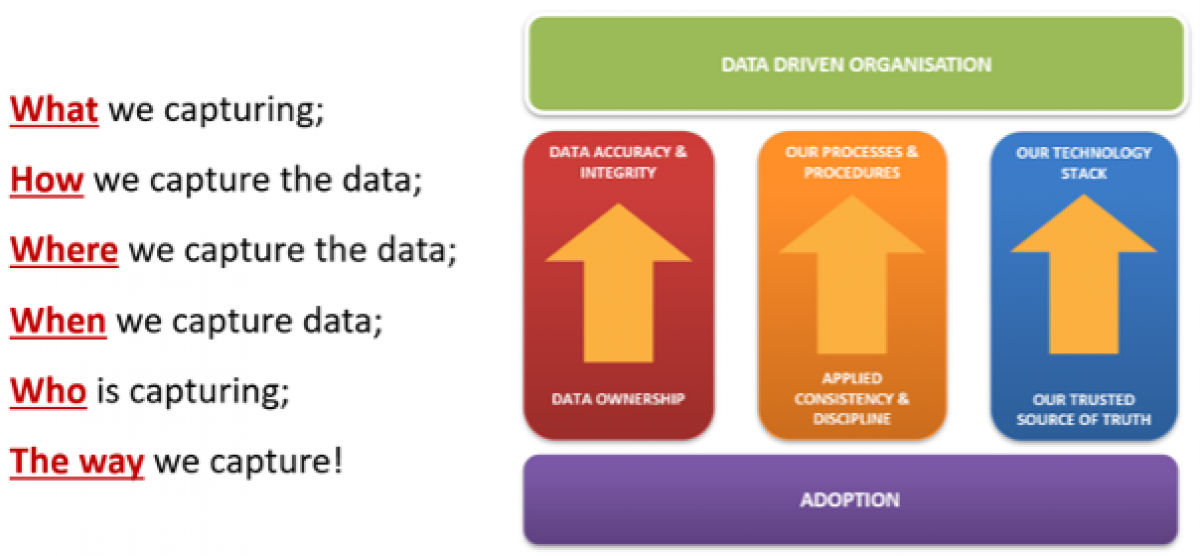
A critical yet often overlooked element of AI readiness is the organisation’s data posture, reflected in how it manages, protects, and utilises its data. Poor data quality, inconsistencies, and silos across departments can lead to unreliable AI outputs. This idea is reflected in Figure 1. The whole organisation needs to be on board with data harmonisation, and processes need to be applied consistently and ethically across all departments from the onset of adoption.
In order to optimise their data posture, companies must assess their:
- Data taxonomy and classification: the structural system for classifying and organisation data into hierarchical categories.
- Data governance and compliance to ensure consistency as the organisation is a living organism where change is constant.
- Data integration capabilities to ensure AI solutions have access to clean, structured, and meaningful datasets.
Without a strong data foundation, AI models can generate biased, misleading, or even harmful insights. Organisations should invest in data management frameworks before they rush into AI development.
Employee dexterity for AI adoption and prompting
AI is not a plug-and-play solution; its effectiveness depends on how well employees can interact with it. AI-driven tools require human literacy and intervention. In fact, the new European Union Artificial Intelligence Act actively makes provisions for this, stating organisations will be responsible for ensuring their staff and anyone involved in operating and using AI systems possess an adequate level of AI literacy.
AI literacy includes technical knowledge, experience, education, and training, as well as the specific context in which the AI systems will be used. It requires human oversight, which is defined as “users [being] equipped to monitor operations, recognise and correct anomalies or dysfunctions, avoid automation bias, interpret outputs accurately, and hav[ing] the option to disregard, override, or stop the AI system safely”.
To achieve this goal, organisations should focus on:
- Training employees in effective AI prompting and oversight techniques
- Developing AI literacy programmes to ensure users understand AI-generated insights
- Encouraging a mindset shift where employees see AI as an augmentation amplifier of their offering rather than an employee replacement strategy.
Without proper training, employee buy-in and effective change management, AI investments will fail to deliver their intended benefits, leaving employees overwhelmed or misinterpreting AI-driven insights, which can lead to resistance and increase the complexity of adopting AI solutions.
Architectural readiness for seamless AI integration
Even if an organisation has the best AI model available, its impact will be limited if the underlying architecture is not designed for seamless integration.
Key considerations for companies when adopting new AI models include:
- Ensuring cloud and on-premises infrastructure can support AI workloads while factoring in future growth capability
- Building flexible application programming interfaces for interoperability agnostic effectiveness, which is interpretable across various systems, including factoring in older legacy systems
- Implementing real-time data pipelines that provide AI with the most relevant and up-to-date information.
A well-architected digital environment ensures AI solutions work efficiently across departments rather than operating in isolated silos.
The importance of ethical AI and AI excellence strategy
As AI adoption grows, businesses must ensure their AI systems are transparent, fair, and aligned with societal values to maintain trust with customers, employees, and stakeholders. Ethical AI helps mitigate risks such as bias, data privacy violations, security threats, and over-reliance on automated decision-making.
The EU is one of the first regions to have taken giant steps in the AI regulatory space, which will be enforceable from August 2026. The EU AI Act represents one of the most comprehensive regulatory frameworks for AI governance, introducing risk-based compliance, data governance mandates, and transparency requirements. To ensure compliance, EU organisations need to start working towards aligning their AI strategies with the regulatory expectations of the Act.
Compliance, however, should not be the reason an organisation adheres to rules. Rather, it should be a strategic move to protect customers. According to Fortune Business Insights, “75% of executives believe that ethical AI will be a key differentiator in their business models within the next three years.”
A few of the key pillars of ethical AI and how businesses can drive an excellence strategy:
- AI literacy and change management
Employees at all levels must be trained to interact with AI effectively, reducing fear and increasing adoption. - Risk management and governance
Businesses must establish ethical AI frameworks, bias detection protocols, and continuous auditing for compliance with emerging regulations. - Human oversight and accountability
Implement governance models that require human review of AI-driven decisions in critical areas. - Sustainable AI deployment
AI should be designed to minimise its environmental footprint while enhancing long-term business resilience. - Visibility and reporting
Bring visibility to the AI ecosystem so that you can drive continuous improvement practices as you mature and it becomes a business-as-usual practice.
Leadership’s role in utilising AI insights for decision-making
One of the greatest failures in AI adoption is when leadership does not fully leverage the insights delivered by a cohesive and holistic AI strategy. AI should not just be an operational tool; it needs to be embedded in strategic decision-making processes, which requires a commitment to trusting AI-driven analytics, defining clear metrics for AI-generated recommendations and collaboration between AI experts and the leadership team.
Leadership must also take proactive steps to ensure that AI forms part of the overall business strategy and is viewed as critical to the organisation. AI can only drive the right behaviours if organisations establish appropriate key performance indicators (KPIs) that align with business objectives.
Embedding AI into organisational KPIs
Often, businesses fall into the trap of measuring success based on AI execution rather than on AI impact. To avoid this pitfall, organisations must:
- Define common KPIs across departments to ensure AI drives cohesive business outcomes
- Focus on criteria that measure AI’s contribution to key business metrics, including efficiency, revenue growth, and customer experience
- Continuously refine KPIs based on evolving AI insights and business needs
- Derive common KPIs set with critical thinking across the organisation to ensure that the right behaviours are supported, rewarded, and adopted.
By embedding AI-driven KPIs into performance measurement, organisations can track tangible improvements and ensure AI delivers real value.
The journey to AI excellence will not be defined by the speed of the execution but by the intentionality and depth of readiness an organisation builds before deployment. AI is not a standalone solution nor a project you implement but a business transformation that must be seen as a journey to walk and earn.
KEY TAKEAWAYS
- Before investing in AI, businesses must question their AI readiness, including data capabilities, governance structures, and workforce skillset.
- Businesses need to clearly define why they need AI and what they want it to solve.
- Data is key to a successful AI strategy, and organisations need to commit to data literacy across the organisation.
- Organisations need to ensure maturity in their data posture to ensure good data quality is produced by their AI tools.
- As businesses grow, their AI systems must be transparent, fair, and aligned with societal values.
- Leadership needs to fully leverage the insights delivered by a cohesive AI strategy.


Gallery