
In an era where access to information is ubiquitous, a new type of war is being waged: cognitive warfare (CW). With CW currently blowing up the information highway, Africa finds itself in the crosshairs.
The weaponisation of information
The weaponisation of thought, CW employs the targeted and strategic manipulation of information for the purpose of waging war and/or achieving strategic goals. CW is more complex than the mere dissemination of fake news. It is planned and targeted to shape, influence and control perceptions, ideas and agendas through psychological operations, the manipulation of information, and the dissemination of strategic communication. It is spread through social media, news organisations, thought leaders, word of mouth, influencers, advertising, political propaganda, diplomacy, and cultural actions, to list a few of its sources.
CW can be used by international “enemies” or within countries to deepen existing divisions by exploiting ideological and cultural differences. The school chair for security & Africa studies and senior lecturer at the Faculty of Military Science at Stellenbosch University, Dries Putter, says, “Africa, with its colonial past, is easy hunting ground for the deployment of propaganda weaponry. This is made easier with the exponential penetration of digital communication technology on the continent.”
In today’s world, CW is further facilitated by artificial intelligence (AI) and machine learning, due to accelerated development of content and a greater ability to plan and execute strategies. Algorithms also fuel CW by creating echo chambers that reinforce the messages it spreads. In addition, technologies such as deepfakes (where AI is used to overlay voices and words to people) and psychological conditioning make it harder for people to separate reality from manipulation.
What makes CW even more confusing is that it is not always about disinformation or malinformation. “It can range from truth to complete lies,” says Putter. “Obviously, the best and most sustainable manner to change perception is through truth.” It is therefore becoming increasingly difficult to decipher what is and isn’t real.
Ultimately, CW creates confusion. Putter says, “It is designed to create and maintain a level of uncertainty to ensure decision-making paralysis in leadership. Recognising CW tactics from all sides, including the West, China, and Russia, for example, is essential for nuanced decision-making in diplomacy, investment, and national threat assessments.”
The players
In his paper, Navigating the interplay of cognitive warfare and counterintelligence in African security strategies: insights and case studies, Putter investigates eight African countries (Nigeria, South Africa, the Democratic Republic of Congo, South Sudan, Egypt, Kenya, Zimbabwe, and Uganda) and how they have been impacted by CW.
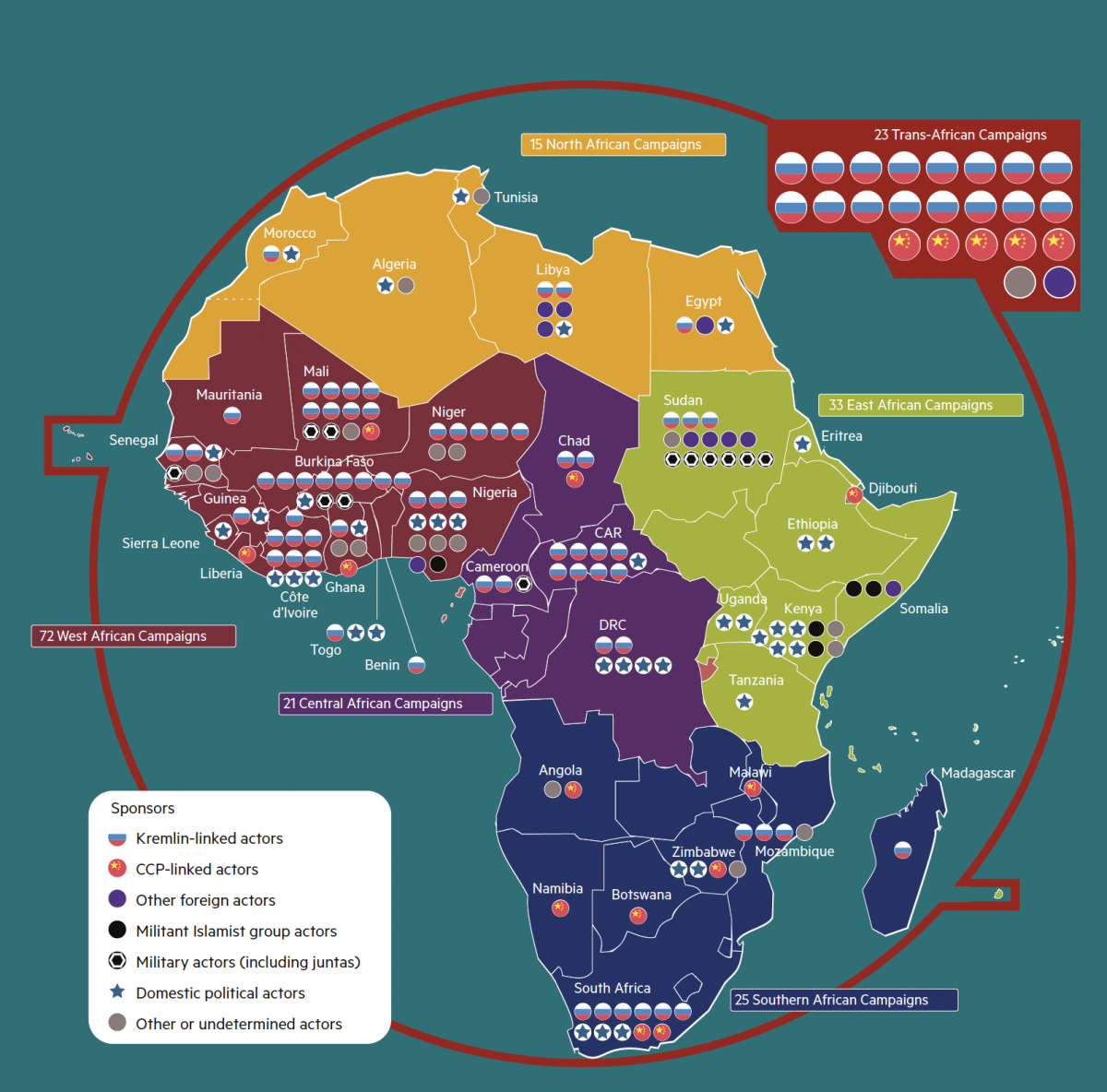
The research suggests that the largest perpetrators of CW on the continent are Russia and China, followed by domestic political actors, military groups, militant Islamic groups, and those from other areas or unknown sources, with their goals including:
- manipulating public opinion,
- discrediting political opponents,
- delegitimising institutions, groups or personalities,
- confusing voters and/or influencing elections ahead of voting,
- reducing confidence in the democratic process,
- creating racial tensions or intensifying ethnic polarisation,
- fuelling regional conflict or justifying military interventions,
- undermining peace and reconciliation efforts and inciting unrest,
- villainising the “enemy” e.g. US and China,
- concealing the truth or offering a diversion to large-scale corruption and political interference, and
- encouraging local support for foreign-funded infrastructure projects.
Russia and China topping the list is unsurprising when you consider that their reported CW budgets are R2 billion and R10 billion per annum, respectively.
China and Russia, however, are not the only countries accused of conducting CW on the continent. In April 2024, the US House of Representatives passed the Countering the PRC (People’s Republic of China) Malign Influence Fund that allocates $1.6 billion for the State Department and USAid to use to subsidise media and civil society sources around the world over the next five years.
USAid*, the US promoter of development and humanitarian aid, has long been subsidising media organisations and the training of journalists across Africa – a strategy that Russia and China have also been accused of using. While many commentators argue that this funding from the US helps ensure African news organisations remain independent, some criticise USAid for being a strategic arm of US foreign policy and this, according to them, is reason to question the independence of African media. Some critics go as far as accusing the US of actively trying to discredit African government ideologies, with Marxist online publication MR Online naming South Africa as a case in point. The US has also been accused by its critics of having a “growing willingness to use disinformation as a tool of psychological operations.”
Across the globe, the European Union (EU), United Kingdom (UK), Israel, Iran and the United Arab Emirates (UAE) have all been accused of conducting CW, whether it is within their borders, or against adversaries in regional conflicts. Indeed, a search of their CW budgets reveals that they all run into the hundreds of millions of dollars per annum.
African countries also engage in CW. Putter says, “Several African governments partake in cognitive and information warfare, deploying state media, digital campaigns, and legislation to influence domestic and regional narratives. The extent of their campaigns varies. Some use defensive measures and others employ proactive messaging to counter foreign influence or secure their national interests.”
What is perhaps more concerning is Putter’s suggestion that some African countries are being manipulated in their CW efforts to aid the much larger CW campaigns of threat actors such as Russia, China, Iran, UAE, France, USA, UK and the like.
The cost
While the true cost of CW is impossible to estimate, Putter says, “CW incurs direct costs such as market volatility, capital flight, disruption to investments, and indirect costs or intangibles such as erosion of social cohesion and erosion of trust in public services and offices, which leads to or reinforces political instability.”
The World Economic Forum has stated, however, that for corporations the costs can run into hundreds of billions of dollars due to market losses and bad financial decisions.
A few isolated incidents do offer an indication of the potential impact of CW on economies. A fake tweet, for example, that stated that former US President Barack Obama was dead, instantly – albeit briefly – erased $136 billion from the S&P 500 index’s value. This is particularly concerning, considering that the Massachusetts Institute of Technology (MIT) found that fake stories are 70% more likely to be shared than true ones.
Navigating the information war
Currently, legal frameworks around CW are weak as it falls within war’s grey zone, namely coercive activities that fall short of armed conflict. Governments, institutions and businesses therefore need to adopt strategies to mitigate the impact of CW.
Suggestions include:
- Collaboration and improved policy responses: This scenario would see global and regional organisations, such as the United Nations and the African Union, collaborating to set ethical standards, develop strong regulations, and strengthen cybersecurity laws that hold malicious actors under their jurisdictions accountable.
“Leaders must cultivate agile intelligence ecosystems, institutional resilience, and cross-sectoral coordination,” Putter says. “The evolving content landscape demands ethical stewardship, strategic foresight, and inclusive public engagement to ensure sustainable governance and social harmony.” - Education from primary to tertiary level: Programmes must be introduced into schools and tertiary education institutions to develop a focus on critical thinking, media literacy, and fact-checking skills. People must be taught to evaluate sources, spot false information, and resist emotional and ideological manipulation.
- Targeted media literacy programmes: Governments and businesses must launch targeted media literacy programmes for civil servants, their employees, and the broader public. Putter suggests this becomes part of every employer’s induction programme.
- Robust intelligence and fact-checking agencies: While governments need to prioritise robust intelligence agencies and include CW strategies into the national defence plan, Putter says the private sector can assist through developing and supporting fact-checking organisations that help counter hostile influence operations, by detecting, attributing, and neutralising destabilisation efforts.
- Education focused on CW: “South Africa has already established a defence intelligence degree programme at the Faculty of Military Science hosted by the Military Academy through a partnership with Stellenbosch University,” says Putter. He says getting the State Security Agency to partner with that programme, for example, would be a quick win for intelligence education and would boost SA’s ability to process reliable intelligence in a fight against CW adversaries on the African continent. Putter also suggests that media professionals should not be educated in a country that is actively engaged in CW in Africa.
- Triangulation of data: Putter stresses that leaders must exercise critical discernment and triangulate information between competing narratives and sources by using intelligence fusion and structured analytic techniques. He says, “[They need to establish] robust information validation systems such as open source intelligence (OSInt), social media intelligence (Socmint), and crowd-sourced OSInt (CrowINT) platforms, expert networks, and transnational data sharing to assist with filtering bias and increase reliability.”
CW – a global economic threat
As CW evolves, we must ask whether it will eventually replace traditional forms of warfare. If wars are not fought on the ground but rather in people’s minds, the implications of this shift are profound. For business or political leaders looking to make informed decisions, there is no greater threat to the truth, and therefore to economies and the commercial landscape.
KEY TAKEAWAYS:
- Cognitive warfare (CW) is a war of mental manipulation, which is aided by digital information, artificial intelligence, machine learning, and algorithms.
- Countries are spending billions to strategically manipulate information and people’s perceptions to achieve their strategic goals.
- The hefty price tag of CW also comes with a broader cost to society, democracy, and institutions.
- Legal frameworks are underdeveloped to address the issues around CW leaving businesses and governments responsible for putting strategies in place to mitigate its impact.
- In the future, CW may become the biggest threat to countries and economies.
*In early 2025, USAid became the victim of massive budget cuts by the Trump administration. Staff were laid off and what remained of its functions roiled into the US State Department. How this affects America’s CW efforts remains to be seen. (Editor’s note.)


Gallery